Janet’s example inspires me to conceive of a scheme in which we proactively pursue a relationship with next-door neighbors at all times. So, for example, the next time Dave’s birthday rolls around, we give him a gift.
I am grateful for a possibly newfound ability to mourn, which I did with Carla tonight when she got a call from Carole saying that the doctors at Geisinger don’t expect Janet to live through the night. It felt good to cry. Faced with death, don’t attempt to console. Simply mourn alongside people. And then when they lose someone, as Janet’s family is about to, help a lot.
Alright, enough Scott-resolution and navel gazing. I am grateful for Janet. She brought gifts for our kids (and sometimes for us) almost every conceivable holiday. She joked a lot. She showed us the value of being friends with your neighbors.
That’s all I want to journal about tonight. Janet’s imminent death overshadows everything else.
“Such people will go on and on about visions they’ve had; they get puffed up without good reason by merely human thinking, and they don’t keep hold of the Head. It’s from Him that the whole body grows with the growth God gives it, as it’s nourished and held together by its various ligaments and joints.”
— Colossians 2:18-19, my emphasis
Paul here—or whoever wrote this wonderful letter—is making a case they the Colossian church shouldn’t listen to people trying to put rules onto them because of visions they’ve had. But I extract a principle here that corrects: Visions are not what will sustain your faith. Connecting to Jesus is what will sustain your faith.
Is Daniel Lanois actually David Ruis? Vocally, I can barely tell them apart.
To an onlooker like me, miracles are intensely distracting.
I am grateful for a wife whose life beckons me to be empathic. She came home from work and told me what she had found out from Carole via Facebook: that Janet has been transferred to Danville for a blood transfusion that she needs in order to be able to go through chemotherapy to fight the lymphoma. Carla told me explicitly that she wants me to feel sad like she does. I didn’t at first, and I still don’t very explicitly. It’s the lack of lucidity, the lack of being there that disturbs Carla—and indeed, that is the most disturbing thing about it. She wants to “doula” for Janet, camping out at the hospital or nursing home or wherever to advocate on Janet’s behalf. Janet had conjunctivitis for days before they put her on erythromycin for it—despite her having said something repeatedly to her caregivers about it. I say go, Carla, go, do the good work of advocating on behalf of the woman who taught us how to be neighbors.
I am grateful for a son who knows more and more what he wants out of...
// read full article →A Birthday Encomium
Sullivan, you are a treasure chest. We’ve known that since the day we were blessed By your arrival eight years ago. But I’ll tell you what we didn’t know: We didn’t know just how rich we’d become, The manifold wealth of our newly born sum. Our 20-inch trunk is now fifty-three tall So say the strokes on our pencil-marked wall. But ‘tisn’t the size of the box gives a rush, ‘Tis the contents therein that make our hearts flush: Humor and trust, ‘magination and joy, Honesty, playfulness, ambition and, boy, Invention and wonder, forgiveness and caring, Spontaneity, patience, focus, and sharing. To know you is to open a lid and behold A beaming assortment of silver and gold— (Or palladium, perhaps, since I know that you’re able To prize all the elements on the whole table). Anyway, there’s so much in our oaken case, That I want to sing all over the place: “Hallelujah, we’re rich! Let’s shower in flowers! For Sullivan Oake Stilson is happily ours!”
Carla and I watched Transcendence (2014) last night as per Instructions. It probably couldn’t have been more perfect taken as a message from God: People think Him less than human and misconstrue intentions. But, as Paul Bettany’s character Max says at the end of the film, ”He created this garden for the same reason he did everything. So they could be together”—the “they” being us. His intentions are purely loving and beneficent, even if His methods are foreign to us.
And that’s just the core of what you can take from it. It can get much richer than that.
I saw an IMDb post entitled, “Humanity Lucks Out With A Benevolant AI God, And They End Him?!?” Isn’t that just what we’re doing with God?
I am grateful for the peace of mind that I have after a cathartic, hollering walk-and-stand with God near the far sheep barn earlier today.
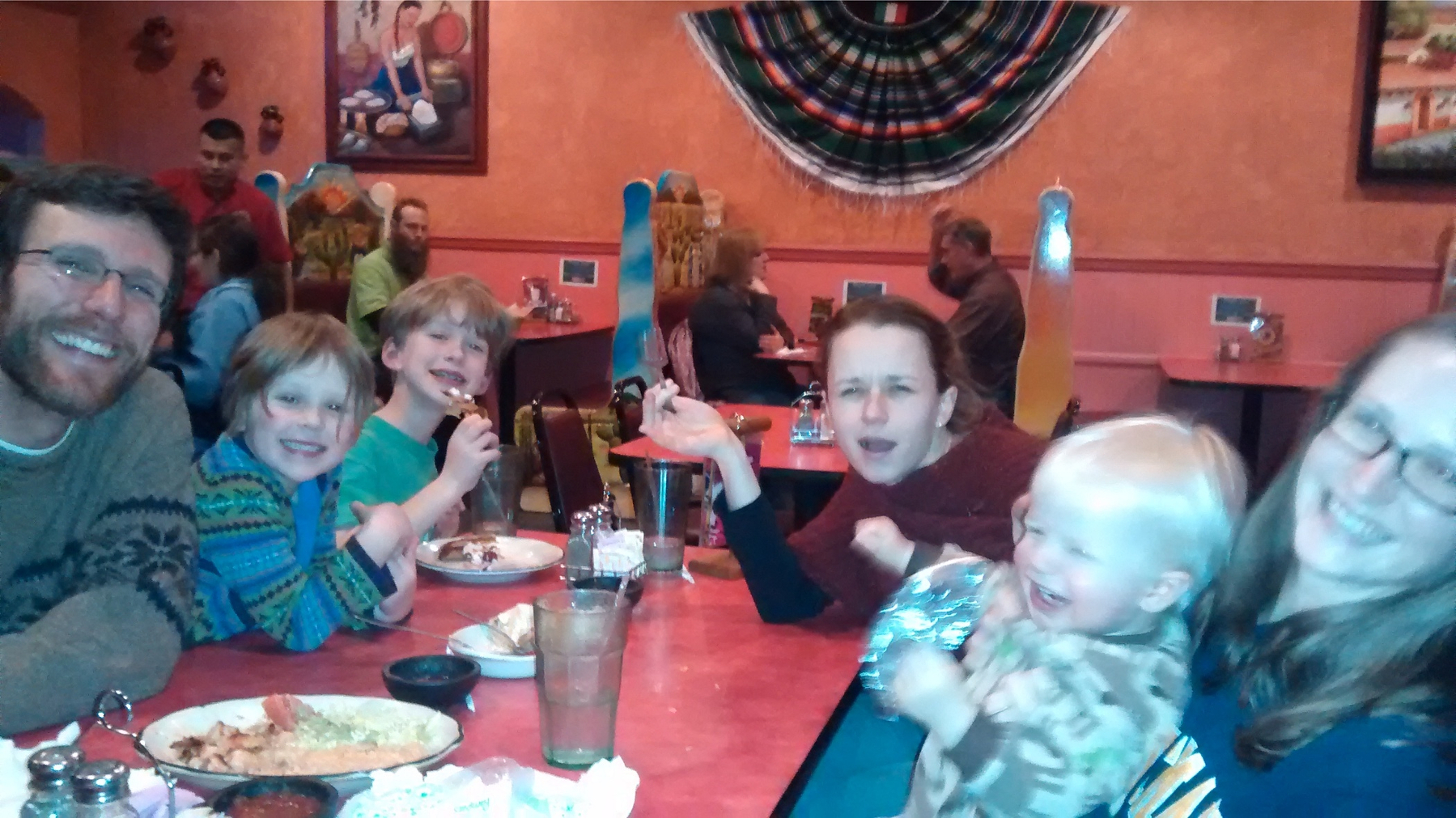
“…we ran into each other at Rey Azteca like we live in a small-town movie script!”
— Ruth
Every miracle has an explanation that competes with the theistic one. For example, Saul’s conversion, Krista’s xenoglossy, Emma McKinley’s healing, Joshua’s dual word of introduction—they are all explicable in terms other than God. Most of the best ones (e.g., the last three above) require the use of explanatory mechanisms yet unknown to science. But some combination of things we do understand—mere coincidence, hallucination, wishful thinking, confirmation bias, misreporting, misdiagnosis, placebo, and hoax—and things we do not understand—extraterrestrials, poorly understood psychosomatic power, the possibility of telepathy—could get the job done in every case.
Following Richard Beck’s lead, I will attempt to answer in quick, bulleted form why I pray, even if and when most prayer requests go unanswered. I pray because in prayer:
- amplifies, directs, and actionizes my empathy,
- pledges my allegiance to God (or, if He isn’t real, the idea of Him and the virtues it represents to me),
- develops self-control,
- helps me sort out my thoughts,
- gets me outside,
- is generally healthy, like meditation, for the mind, and
- does, particularly on those rare occasions when I feel like God is directing me to pray something very specific, lead to answers!
Thinking about prayer and remembering Luke 11 and Luke 18, it seems to be Luke’s assumption that God will seem very often seem unresponsive and unjust to us in His delay in answering prayer. It’s probably the norm. We should not be surprised that most prayers appear to go unanswered. But God won’t delay forever: At most, it’ll be the wait of a single lifetime before all begins to made right in the life of the elect (AKA, all of us). Because when we’re in His arms, everything will be A-OK.
This could hold even if Jesus was mistaken about when He was coming back and that’s the quickness to which He was referring.
It certainly won’t hold if God is a fabrication. But if you read the next entry in this journal, you’ll see that most of my reasons for praying hold even if God is a fabrication.
Everything I pray for must lead to action on my part as well.
love noun 1 Self-donation (e.g., of attention, energy, time, material resources, money) for the good of another, ideally driven by affection, and if not that, then by principled regard for others as at least as important as oneself
When we say “I love you” to someone, we mean that we desire to love them as above.
Boy, does my desire to journal nightly wax and wane.
Anyway, today I am grateful for the time Éa and I spent before a magnetic board at Schlow Library with magnetic letters. She was sorting the letters when I walked up, then we started a game in which I would spell a new word to her and she would read it. I got to introduce her to words like “anodyne” and “arachnid.” She enjoyed it—and read everything very well. Later, after I had gone upstairs to pick up a LEGO architecture book for Sullivan and a copy of Wally Pfister’s film Transcendence, I returned to find she had spelled the word “xilafone” all by herself. She was just so chipper and engaged about the whole thing. I like Éa very much.
I am also grateful for rebound from a first hour-and-a-half at work today of distraction (Michael Shermer, Keith DeRose, John Piper) that started as I wanted to corroborate Ethan’s report that members of ISIS are converting to Christianity because they have visions of Jesus. I found new clarity and...
// read full article →Online discourse is not where I want to live life.
I want to list the commands of Jesus as recorded in the New Testament, plus the commands of the other New Testament writers.
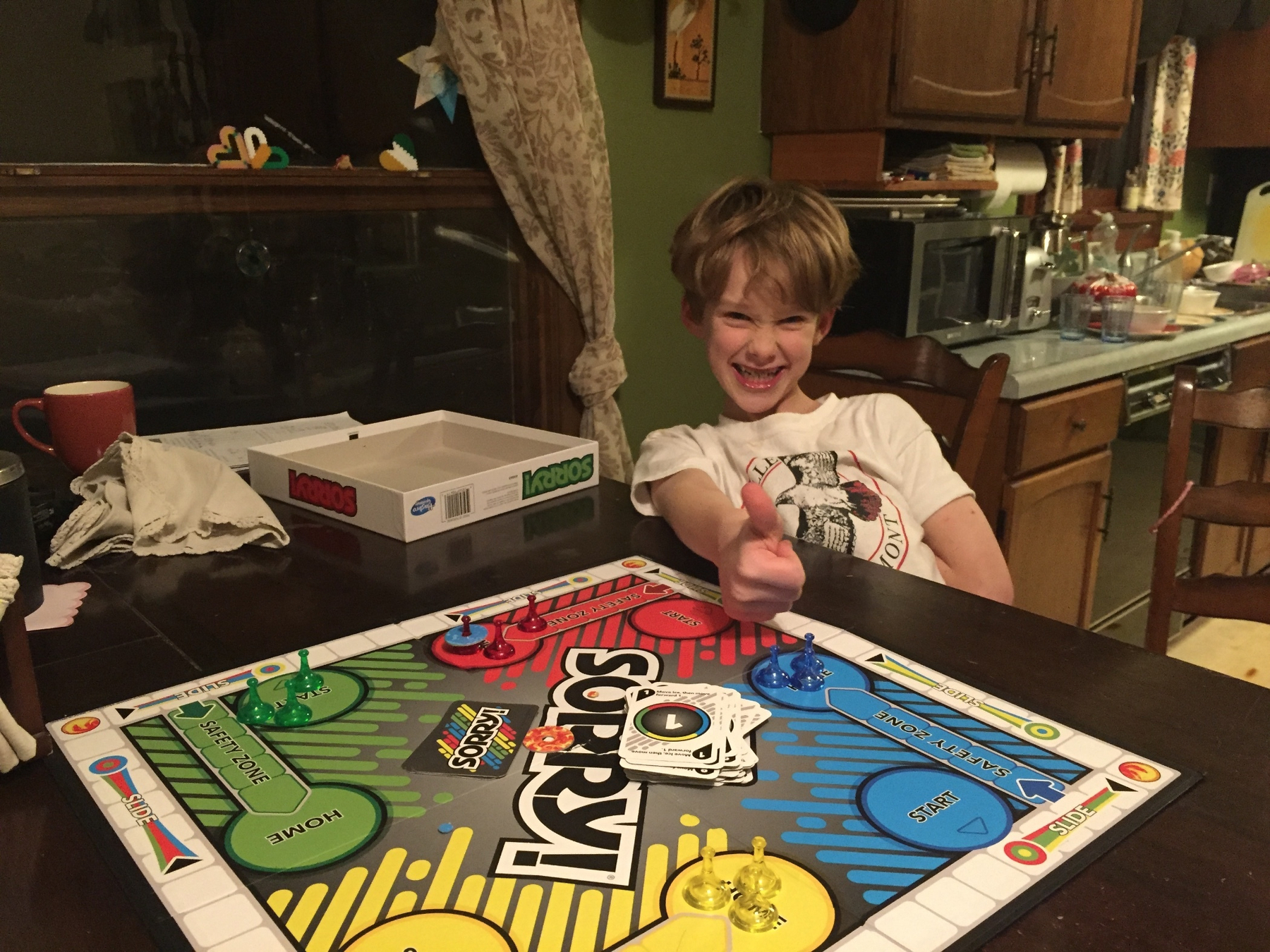
Sullivan won the closest game of Sorry! conceivable this evening on our date.
Father, thank You for all good things: the College Township Bikeway, a family that enjoys walks, the Rookes, the rest of church, a healthy family, enjoyable music, good food, travel plans, gratitude, and so on, and so forth.
Father, please restore Janet’s health that she may live out the remainder of her days happy and well-related to her family, friends, and neighbors. Please hear Éa’s prayer at dinner today that our neighbor might come home from the hospital.
One could make a formula that would calculate the solidity of my conviction that God is real. The formula’s elements?
- the amount of sleep I’ve gotten,
- the degree of self-control I’ve been exercising, and
- the last time I prayed.
With my current apathy toward orthodoxy and my uncertainty about the whole thing at all, I hope He is moving me toward faith-as-action. I hope this uncertainty is moving me toward action. But whither? In what fields shall I imitate Jesus? How will my imitation be different from before, when I was 100% certain of all my theology? Is He removing my certainty, or am I? Am I just making up this move to console myself as my faith withers? Or is it real?
How do I sing to Him I do not know?
Well, I asked to see Jesus: My Peruvian friend César got evicted from the defunct Internet café where he was sleeping two days before Christmas. Then, on New Year’s Eve when he was sleeping under a bridge, he was attacked and robbed. He is without food or money, and he was prescribed and charged for some medical cream that he obviously cannot afford.
Father, grant César, Carla, Roberto, and the folks at Misión Familiar Internacional compassion and wisdom.
Actually, while we’re at it, a healing miracle or a miracle of provision—or really any direct touch from You—would be swell.
“Housatonic” means “beyond the mountain place,” and to me it means that my source of life and faith must come directly from You, not mediated by reading others.
You’re daring me to find You by helping others (Matthew 25:31-46).