Baby, I need your lovin'
Got to have all your lovin'
— The Four Tops
I woke up with these lines in my head yesterday morning. They were not accompanied by any assurance that they were from God. Perhaps I should stop noting the ones I’m not sure about, lest I give the impression that I’m suffering from severe confirmation bias.
Yet there is no reason to not make something good of this delivery from my subconscious mind: God wants all my loving. Actually, to be more precise, my first, most prophetic-sounding idea from this lyric was one of keeping my eyes fixed straight ahead, not frittering my attention on wasteful, lustful, unloving. It’s basically a reiteration of [1 Corinthians 16:14](1 Corinthians 16:14).
I am most comfortable in situations where I feel the superior. This is probably true of most people, but I noticed it this evening when my friend and his new squeeze came over with his sons at Sullivan’s request.
Would that I would take that comfort in my own skin with me in all social settings.
I was asked in my dream who the three greatest presidents of the United States were. I replied:
FDR, who got himself elected to four terms and helped the country through the Great Depression through strong executive action and the creation of government work programs,
Jefferson, who, if he did nothing else, made the Louisiana Purchase for cheap, and
Teddy Roosevelt, who, I said in grateful tears, established our national natural resource conservation program.
“Don’t judge me” is, hope, something you’ll never hear me say. I, for one, look forward to being judged. I hope you do, too.
Most of us here on Twitter judge every day. You can’t have justice without judgment, by the way. (HT Dale Allison). If you must defend yourself against judgment, perhaps it’s better to say, “Don’t misjudge me” or “Don’t condemn me.“
“Let the seasons begin,” sings Beirut in my head as I wake up. A fair enough piece of advice for a time when I’m upset that I’m not doing anything with my life after Dylan and Noah leave.
For posterity, I’d better explain: Fostering Dylan and Noah lent me noble purpose. Sending them back their parents removes that purpose, which sends me reeling. It doesn’t help that my friend comes over last night with a young man who is determined to build physical environments conducive to the formation of Christian community, after spending the last few days touring the town talking to community-minded folks like Christian Baum of co.space, Joel Martin, and the staff of the College Township government administration, so as to pick my brain about Christian community, something about which I don’t know much. I leave that conversation and go to bed angry that I’m not doing anything “kingdom-minded” or noble.
You, God, or my subconscious mind tells me as I wake up, “Let the seasons begin.” For...
It may help in interpreting Jesus’ parables to picture Him saying them to people, or perhaps to picture yourself saying them to people. That clarified the Parable of the Wedding Feast for me today.
“God will send upon them a deluding influence so that they will believe what is false” (2 Thessalonians 2:11).
This evening, I am uncomfortable with men ascribing action to God. It makes me want to throw out all of the parts of the Bible where that happens. Why would God send a deluding influence on anyone?
The Bible is very clear about condemning sexual immorality. But there is but one moral absolute: love, that is, self-donation for the benefit of another motivated by a view of that other as wonderful. While that pole means a lot of human-facing behavior will remain classified as immoral in almost all situations (adultery [although not, perhaps, consensual extramarital sex], stealing, killing), some behavior, like same-sex sexual activity, will be reclassified over time. Culture will condition to what degree a specific act is immoral.
Éa: So when I was on my way home from the park, and old man and an old woman were walking on the path and they said, “Are you all by yourself?” So I told them, “Um, no my mom said my brother and I could go to the park and she’s just right over there,” and I pointed to my house.
Carla: But I didn’t know you were going to the park. You didn’t tell me.
Éa: I know. It was just the easiest way to get a worried old man and and old woman out of my way.
I don’t always mind the aches and pains and the memory glitches that attend aging. They remind me that night comes. My hope is that light shines in the darkness.
— Dale Allison, “Heaven and Experience,” Night Comes (2016)
This spoken after I saw a gal at Torta’s wearing a “Girls to the Front” jacket, which has something to do with Riot Grrrrls, which is a feminist music movement out of the Pacific Northwest.
I sent a message to Carla upon watching the sunset from West Point saying, “If God is only as beautiful as this, He is enough to hold my attention for eternity.”
After returning the bike to Velo, I spent the entire walk back to the hotel worrying about where to put my stickers—the place stickers I get for my bike and the Restoring Eden stickers—in a place where they can be on display forever (so my computer, water bottle, and bike, which I think I’ll be replacing in the next ten years) but not call too much attention to myself or violate the virtue of humility.
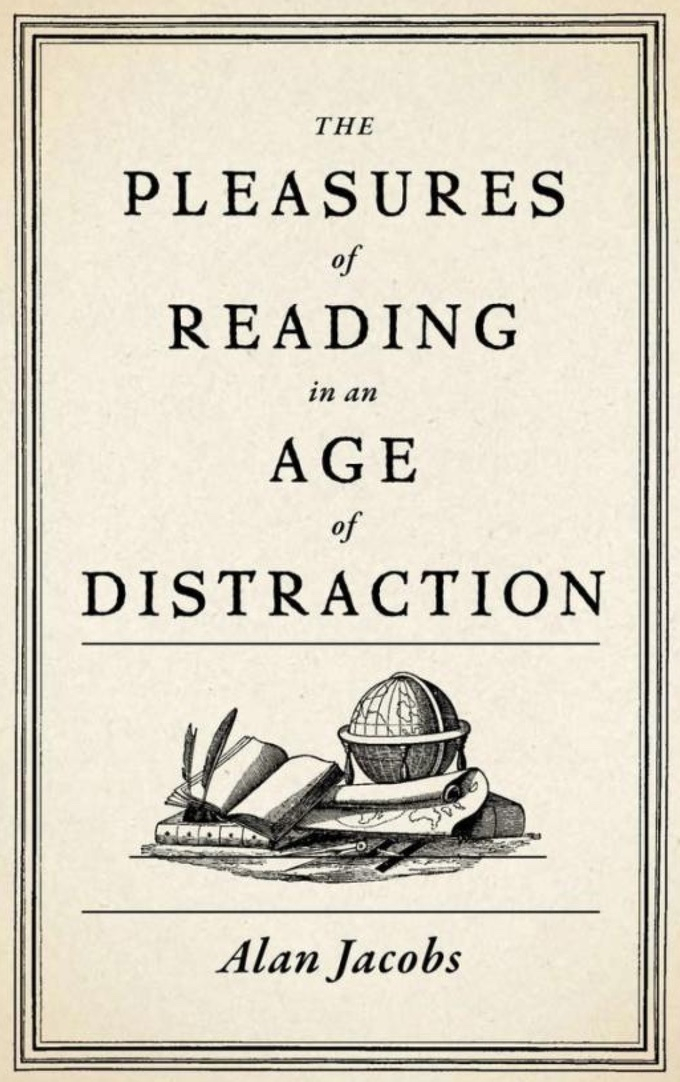
As I read again a few reviews and the publisher’s description of Alan Jacobs’ The Pleasures of Reading in an Age of Distraction, this time from the corridors surrounding the escalator well at the Washington State Convention Center, I teared up in gratitude as I concluded, tentatively as always, that You, God, had once again spoken directly to me for my good.
The message: You and those around you will be enriched if you heed Jacobs’ advice about reading, which Oxford University Press outlines as:
read at whim,
read what gives you delight,
and do so without shame.
I’d add to this, as I’m sure he will in the book: read deeply and at length.
Why so grateful to God? Well, first of all, because You continue to speak to me in these little words and names I remember upon waking from a night’s sleep. I think I can tell the difference between a random surfacing of my subconscious mind and when You are speaking. But also because this speaks directly to an inner predicament I have felt acutely...
So have you seen your “Kings have no power other than what their subjects give them” anywhere else? Thinking more and more about it in light of 1 Corinthians 1:18 and the Cross being the demonstration of the power of God—precisely because it is the means by which he frees his subjects to become like him.”
me:
I’m not aware of anyone who formulated that thought before I did, although I do connect the highly circumscribed nature of human kingly power to the highly circumscribed nature of divine kingly power posited via the theodicy work of Greg Boyd, Thomas Jay Oord, Christopher McHugh, and John Caputo via Richard Beck. That last link you may find too progressive and deconstructed (as I do), but nevertheless useful. That last link is especially useful because come to think of it, Beck isn’t doing theodicy work with that blog series: He is formulating a rally cry for action. And so are you.
We are ready to send Everett and Oak home. But we’re not. I’m sure these are the typical feelings of a foster parent. Life is going to be different. Quieter. This evening without them because they’re with Mommy and Daddy makes that sure. But as Everett would surely reciprocate, “I will miss you, Everett.” And I will miss you, Oak. We still have three weeks with them, so let’s make them count.
We asked Éa and Sullivan today whether they’d like to foster again. Sullivan said, “I’d like a year.” And Éa said, “Yeah, in like, five thousand weeks.”
A home is fuller if you’re stretched for the sake of relationships. Let us dig in to more people. Let us “love [our] enemies, and do good, and lend, expecting nothing in return” (Luke 6:35). Then I will live without regret.