Just finished reading: “Contemplation as Rebellion: The case for unenchantment” (2025) by Nicholas Carr, whose main ideas are that to patiently, contemplatively attend to things is to engage ourselves and our world in the best way—especially contra a society rife with stimulation and mere perception. And it has nothing to with “enchanting” anything.
Just finished reading: “Beyond Words: On the role of silence in film and faith” (2025) by Arthur Aghajanian, whose main idea is that filmmakers can use and sometimes—but not often enough—do use silence to draw viewers in to spiritual experience.
Just finished reading: “From Dietrich Bonhoeffer to James Cone: The complexities of forgiveness in a racialized Society” (2024) by Reggie Williams, whose main idea is that in America, Black forgiveness is a maintainer of the status quo.
Some striking quotations:
- “Can forgiveness find a footing in broader systemic realities?”
- “To encourage [Black people] to see their suffering as righteous obedience to God in Christ is to sanctify a perpetual social death.”
- “In a moment of racial distress, forgiveness becomes a reflex response that serves the social maintenance of racial hierarchy.”
Some quick reflections: This is why forgiveness without amends is usually bad.
Potts is right that punishment and recompense will always be incommensurate with the wrongdoing (except for restitution, which can come close). That’s how you can say that forgiveness and justice can and do coexist: Forgiveness doesn’t say nothing is due; forgiveness says that what’s been paid is enough. Nothing more is due.
Just finished reading: “Forgiveness ≠ Reconciliation: Wisdom for Difficult Relationships” (2024) by Yana Jenay Conner, whose main idea is well summarized by the title. This was my favorite article in the Winter 2024 issue of Comment. Conner helped me realize that Matthew 18 contains a righteous unforgiveness: “And if he refuses to listen…let him be to you as a Gentile and a tax collector" (v. 17). And these two partial quotations struck me as beautiful: “I was a daddy’s girl without a dad…” and “Even if I was interested in adjusting my grip on the cross…”
Just finished reading: “Promise, Gift, Command: Mapping the Theological Terrain of Forgiveness” (2024) by Brad East, who main ideas can’t really be summarized but can be itemized. According to East, forgiveness is:
- from God [meaningless],
- peculiarly Christian [false],
- integral to but not the whole of the gospel [agreed],
- administered by the sacraments [false],
- tricky [can be, but not as a rule],
- when we extend it, evidence that we have been forgiven ourselves [can be, but not as a rule], and
- something about which he still has several important questions [good, because he is muddled and hasn’t written a cogent essay here].
Just finished reading: “Out of the Depths: How Forgiveness Brought a Sex Offender Into the Light” by a man who fell and “Into the Depths: The cost of forgiveness will be your life” (2024) by a wife who forgave.
The man who fell submits that both easy acceptance and permanent excommunication are not good, the former creating dysfunctional communities by ignoring the woulds of the aggrieved, and the latter destroying the sinner. (For my part, I’ll add that the latter also creates dysfunctional communities.) His wife forgave him, doing neither of the above. And by that, he was saved. It even elicited repentance, he says.
The wife who forgave says she forgave he husband, and it has cost her a lot. But it’s the way of Christ, and it, she says, has made her holy.
Just finished reading: ”New Eyes: Forgiveness is not erasing” (2024) by Amy Low, whose main idea is that there is danger that forgiveness will unjustly erase the past. There is also a danger that unforgiveness will spoil potential futures for aggrieved and offender alike. Let us avoid both ditches as we walk the path.
I dedicated the new TV I bought to the Lord. That felt like syncretism.
“Go, eat delicacies and drink sweet drinks and send portions to whoever has none prepared, for the day is holy to our master, and do not be sad, for the rejoicing of YHWH is your strength” (Nehemiah 8:10, Alters). The enjoinment to enjoyment along with generosity, both in the name of the Lord, warms my soul.
Just finished reading ”Punishment and Retribution: An Attempt to Delimit Their Scope in New Testament Thought” (1965) by C.F.D. Moule, who argues that Retribution as satisfaction of abstract scales of an abstract justice is a sub-Christian and sub-personal idea. Punishment as reformatory, protective, or deterrent is fine. My take: Agreed, although he doesn’t spend enough time or brain reinterpreting the biblical passages that challenge this thesis, nor offering much of a picture of how the punishments mentions in the New Testament do work. In fact, he spends most of the article very weakly dismissing counterevidence.
I finally feel comfortable with my grasp of the relationship between non-retaliation, forgiveness, and reconciliation, together with God’s will regarding all three:

Mercy can be unwise.
Mercy is by definition unjust.
Just finished reading “Die With Me: Jesus, Pickton, and Me” (2006) by Brita Miko, who argues that we need to love and forgive even the worst of sinners if we’re going to follow Jesus. My take: Not if you think forgiveness should be granted without confession and repentance, as it seems Miko does.
To love God is to want to delight Him.
I am the In-Betweener:
I’m never satisfied.
Is that I’m keener,
Or am I just a bag of pride? ✏️ 🎤 🎵
Is it passionate love
Or just a love for passion? ✏️ 🎤 🎵
I feel more nervous running A/V for a 200-person address than I do addressing the 200 people.
A potential revolution for memorizing lyrics: Write them down. Why haven’t I been doing this all along!?
“There is no escaping the fact that want of sympathy condemns us to a corresponding stupidity.”
— George Eliot • Daniel Deronda (1876)
Roughly my sophomore year in college, I started using Georgia for school papers instead of Time New Roman. Why? Because it’s bigger at the same point size, hence easier to get to “four pages, double-spaced, size 12 font.” (Not to mention it’s easier on the eyes.)
May all of our eros be agapified.
To insist it is my civic duty to read about, think about, and talk about tyrants only augments their tyranny. Ignoring tyrants is my preferred mode of protest. NB: This is not the same as saying I will ignore the effects their tyranny has on my neighbors.
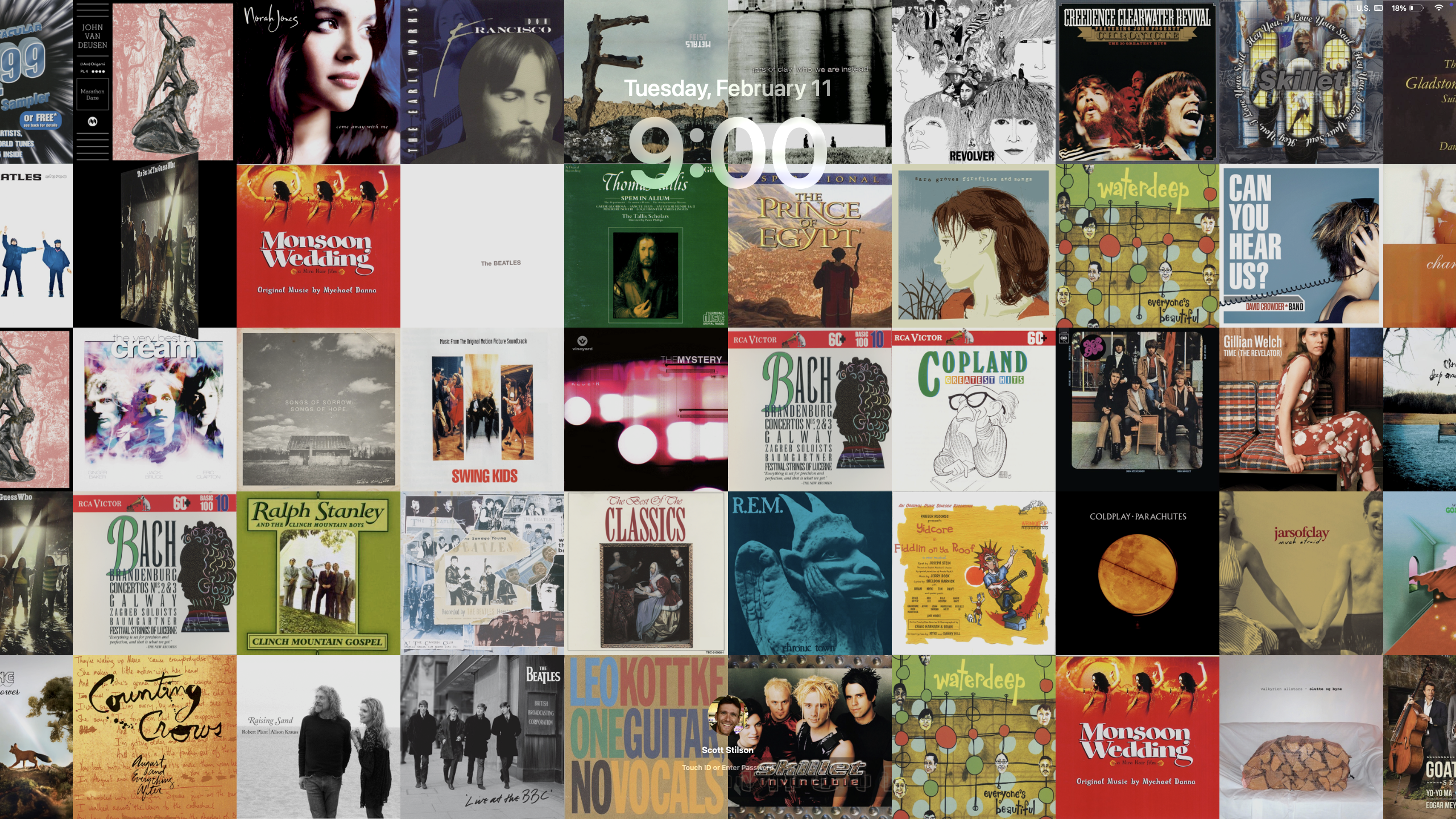
Watching this classic macOS screensaver featuring the cover art of the CDs I own is the closest I come to swimming through piles of gold coins like Scrooge McDuck.
A movie and dinner > dinner and a movie. More to talk about and less trouble falling asleep that night.