Everything I pray for must lead to action on my part as well.
One could make a formula that would calculate the solidity of my conviction that God is real. The formula’s elements?
- the amount of sleep I’ve gotten,
- the degree of self-control I’ve been exercising, and
- the last time I prayed.
“Housatonic” means “beyond the mountain place,” and to me it means that my source of life and faith must come directly from You, not mediated by reading others.
You’re daring me to find You by helping others (Matthew 25:31-46).
I am grateful for the opportunity to help Janet in her time of need. But I want need not to be! Carla has visited a few times over the past several days because Janet has been loopy because of some medication she is one in connection with her perma-asthma that set in this winter like last. Apparently, MRIs at the hospital today may have revealed lymphoma.
I am grateful for the resilience and emotional maturity Éa displayed upon getting her ears pierced at Ikonic Ink downtown today. It hurt, but she displayed (and was multiply congratulated by onlookers for) stoicism while Miranda the “piercing artist” was doing her work. When it was done, she cried honest, quite-but-unashamed tears in Mommy’s arms. May all my children know what to do with their sadness and pain.
And may more families make family outings at tattoo and piercing parlors?
I am grateful for the moment of clarify I had reading Romans 14 this evening: If I let Paul’s use of the word “doubt” (diakrino) in vv. 22-23 interpret James use of the same word in James 1:5-8, then it is clear that Boyd’s thesis about “doubt” not being synonymous with uncertainty is true.
Actually, reading all of Romans 14, which touches on ritually-based vegetarianism and people following their own consciences, was exciting.
I am grateful for the light resolution I made while on my evening walk tonight that I can thank God for everything good and usually thank someone else for everything, too—a resolution I put into practice by thanking Christian Carion for making Joyeux Noël, which we watched with the Rookes last night.
I am grateful for Carla, whose beauty and diligence inspire me.
“I do not want to merely be called a Christian, but to actually be one.”
—St. Ignatius, as quoted by Stephen Crosby
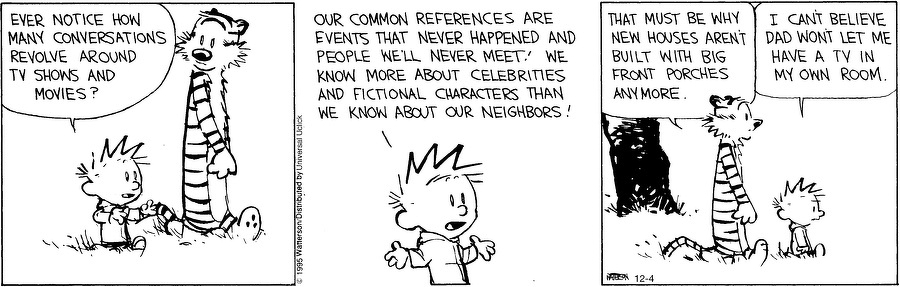
This is how I feel.
Doubt baby review:
- empathy
- action-orientation (Jesus' main thing)
- final marginalization of Teen Mania-esque emphasis on making converts
- metaphysical flexibility (for me and for others)
- humility
- pluralism & ecumenism
- lightheartedness
- reset for my fight against sexual sin
- reset for my distraction at work
I am less self-disciplined, less loving, and less diligent whenever Carla leaves.
Carla has been peevish recently. But so have I. It’s a cycle. I realized one way to break the cycle is to drop my expectation that anyone, including my wife and kids, act perfectly lovingly all the time. I don’t, so why should I expect them to?
I’ll go further: When a demand is made of me or a disagreement voiced, let my first instinct be to satisfy the demand or come to accord quickly and happily. Obviously, I won’t be a pushover, but I will be a volunteer, a happy second-miler.
For this reason we don’t lose heart. Even if our outer humanity is decaying, our inner humanity is being renewed day by day. This slight momentary trouble of ours is working to produce a weight of glory, passing and surpassing everything, lasting forever; for we don’t look at the things that can be seen, but at the things that can’t be seen. After all, the things you can see are here today and gone tomorrow; but the things you can’t see are everlasting (2 Corinthians 4:16-18, KNT).
We look at the things that can’t be seen. That’s a religious paradox strict empiricist might choke on. But besides being poetic, it’s true, and whether the objects of our gaze are real or not, our hope in them has real sustaining power.
It’s also leads to a thought we as believers ought to remember: We are, in the end, talking about Someone invisible. Why balk at the idea that some folks don’t believe?
With apologies to philosophers and neuroscientists who believe there is no such thing as free will, we humans are the only (or perhaps one of just a few) species capable of choosing what we consume and how. We have a huge responsibility.
As this first day of my sprint toward getting a minimum viable website up for Frank and PolyGreen America ends, I am reminded that hobbies are happiest when they are not only enjoyable, but also seen as a form of generosity. In the case of web-development-on-the-side-that-disturbs-my-schedule-equilibirum, the enjoyment is possible only when I view it as such.
So Lord, let me renew that vantage on this work—and all work, really.
The important thing is not to obsess.
If, when I’m old, you were to ask me to tell you one thing about my life as it was today, I predict I’d tell you it was I day I think—I hope—I turned a corner in my character. You see, since screening the finale of the second season of Gatiss & Moffatt’s Sherlock this past Saturday, entitled “The Reichenbach Fall” (and probably a good bit before then), I had been obsessing over the show: obsessing about its plot, obsessing about its characters, obsessing about its actors, and obsessing about its writers. I was obsessing about my decision to stop watching it because of my obsession.
I needed to be rescued from all this.
And it’s more than Sherlock: In recent months, I have spent far too much time and attention setting up operating systems, selecting an iPhone case, and other such minutiae. I prioritize trivialities. And it robs me of life (and steals from DiamondBack).
We have overcome perfectionism. We have overcome stoniness. We have overcome self-distraction at work. We have overcome religious doubt. (All of the above are still works in progress, but they are works well on their way with clear paths to completion.) Perhaps now we can take on obsessiveness and the resulting misprioritization.
Deliberation, yes: You do that about problems and decisions. Cogitation, yes: You do that about profundities. Obsession, no: You do that, by definition, with things you ought not to. And I know what it feels like.
If you’re going to obsess about anything, do it about giving yourself for the benefit of other people.
If, when I’m old, you were to ask me to tell you one thing about my life as it was today, I predict I’d tell you we had our 72-year-old next-door neighbor Janet Donald over for leftover Stilson rotini dinner, homemade quick bread, a thirteen-year-old shiraz Janet had donated to us a month prior for Carla’s birthday, and some after-dinner Dixit at the kids’ prompting, all while piano jazz played on Spotify and the thermostat was set to a balmy 67°F.
I told her I love having her over.
Did I say it because I love the feeling of moral pride it gives me to know I have my aged next-door neighbor over for dinner and counter her as a friend? In part, yes. But I also said it because I really do like her.
“Now you together are the Messiah’s body” (1 Corinthians 12:27, KNT). In other words, I extrapolate, we are how Jesus acts on this earth.
Matt Poehner has the following quotation on his Facebook profile:
Live a good life. If there are gods and they are just, then they will not care how devout you have been, but will welcome you based on the virtues you have lived by. If there are gods, but unjust, then you should not want to worship them. If there are no gods, then you will be gone, but will have lived a noble life that…will live on in the memories of your loved ones. I am not afraid.
— Marcus Aurelius
I can get behind that.
If, in my old age, you asked me to tell you one thing about my life as it was today, I predict I’d tell you it was the day I metaphorically threw my hands up in the air about whether I have a principled reason for supporting Friends & Farmers Food Co-op: I don’t. I support the co-op because I enjoy hanging out with those kinds of people at the kinds of functions they hold.
I could go into my reasons for suspecting that “buy local” is a slogan with slippery ethical foundations (hint: for a start, it smacks of egogeocentrism), but I think I’ll leave it at this: I buy local for the pleasure of it. That’s all. It is a luxury. It makes my community a smilier, more human place.
Completism is not a fruit of the spirit.
On God
#Personifying the highest good is very motivating, even if it’s false (which I don’t think it is, but it might be).
As I read these healing stories from gate A22 a few minutes ahead of boarding for Las Vegas, it occurs to me that there is a singular inner focus I can carry in life that will make for healing prayers and acts of mercy and friendliness and whatever good and God I can do: keep the foot washing in mind.
Attributing the healing miracles I’m reading about in Eric Metaxas’ Miracles to rare, poorly understood, completely undivine, powerful psychosomatics because one has to avoid confirmation bias is like remaining agnostic about the origin of a love letter left for me in Carla’s handwriting with her signature on it. If it’s in her handwriting and name, it’s rational to conclude that she wrote it. Similarly, if these miracles happened in the name of Jesus, it’s rational to conclude that Jesus did them. Is it possible that some purely natural, impersonal set of biological and psychological forces combined to make these healings happen? Yes, just like it’s possible that I forged the hypothetical love letter subconsciously out of a desire to be loved by Carla. Do I have any explanatory mechanism that is more powerful than to attribute the healings to God and the love letter to Carla? No, not even close. Does it seem overly skeptical to withhold conclusions about the origin of a miracle when it happens in Jesus’ name and has no great natural explanation because science might someday understand what is happening? In many cases, such as in the cases of these stories, yes.
If you asked me in my old age to tell you one thing about my life as it was today, I’d tell you that Matt and Lara were good friends of ours, and they proved it yet again by coming over this evening and Matt helping Carla figure out what to do about the hole she had made in the kitchen wall two years prior in hopes of someday widening the doorway putting a pocket door or barn door in. We needed to get moving on something because having a hole in the wall with exposed electrical wires was a no-no for folks wanting to get into foster parenting. Lara did the dishes and prepared one of the two pizzas we scarfed for dinner (along with some beer from Otto’s—a rare sighting in the Stilson house). The Rookes also proved good neighbors in general: Matt helped me shovel out neighbor Janet’s driveway when her snowblower wouldn’t start.