When man invented the bicycle he reached the peak of his attainments. Here was a machine of precision and balance for the convenience of man. And (unlike subsequent inventions for man’s convenience) the more he used it, the fitter his body became. Here, for once, was a product of man’s brain that was entirely beneficial to those who used it, and of no harm or irritation to others. Progress should have stopped when man invented the bicycle
Both our capacity for connection and our capacity for separation have to be cultivated into responses that are life-giving and life-sustaining. The power to hold and the power to let go, to connect and to disconnect, each of these powers can be used for good or for ill.
Ethical maturity learns the difference and knows the right time for each. Neither power can be valorized as an absolute good without risking harm.
“Today you are young and very much in love and you think that your love can sustain your marriage. It can’t. Let your marriage sustain your love” (Dietrich Bonhoeffer, “A Wedding Sermon from a Prison Cell” in Letters and Papers from Prison, as quoted by Griffin Gooch
It’s been awhile since I’ve attended a wedding. Are we hearing this kind of advice very often these days? I hope so!
“[Jimmy Stewart] may have been the least neurotic actor I’ve ever been around. He was almost too nice. No airs, never demanded special attention, seemed to always keep his insecurities to himself even when he was a kid in his twenties” (a stagehand who worked with Stewart in 1934, according to Scott Eyman in Hank & Jim).
“…least neurotic…always keeps his insecurities to himself…” This is part of why Jimmy Stewart is the closest thing I have to a hero. Not that I think you should keep your insecurities entirely to yourself; just that their airing is best kept to a very close circle. What’s the point in burdening everyone else?
“Amateur work is fun but the price for it is just simply tremendous. In the end you get ‘Thank you’ and that’s all. You give three performances which everybody promptly forgets and somebody has a breakdown—that somebody being the enthusiast” (F. Scott Fitzgerald to his daughter, trying to persuade her away from amateur theatre, as reported by Scott Eyman in Hank & Jim).
I recognize the sentiment, and it’s part of why I don’t do shows too often: Mounting them is a lot of work to be doing it for free!
Challenging art teaches you that lesson [that you are not yet what you could be]; great art insists on it. A great novel is, among other things, a document that is more human than human, that goes further than it has to in the effort to convey the human experience. A great, challenging novel knows things you don’t, says things that will not flatter you, and will not stop doing its work until it’s rearranged something in your chest. And who could stand that? We’ve spent years learning that discomfort is always, always a sign of harm. And so we took the only reasonable action a therapeutic civilization could take with an art form built on productive discomfort: we got rid of it. We replaced it with #content, which is art that has agreed as a condition of existence never to ask anything of you at all.
His partial etiology isn’t convincing, tempting though it may be because I share his animus for real coddling I do observe around me. Even the phenomenon for which he is attempting provide an etiology is questionable: There’s nothing new about people shying away from demanding art, whether the demand is moral, as he seems mostly to have in mind here, or cognitive, owing to formal obscurity.
But I could sing his partial definition of a great novel.
I think I ought to start steering clear of politically charged, interplanetary sci-fi. (I’m thinking here of how I couldn’t finish Dune.) The subgenre just doesn’t seem to do anything for me. It could be that I’m just not into politics, i.e., all activities concerning questions of who is in charge of what and how those people make the rules.
But there were certain quotations I found beautiful or thought-provoking:
“That vivid memory and the cool, vast touch of night wind awakened him. His soul came out of hiding” (narrator of Shevek).
“Variety doesn’t come with just moving around. I was all over Anarres, young. Drove and loaded in every Division. Must have known a hundred girls in different towns. It got boring. I came back here, and I do this run every three decades year in year out through this same desert where you can’t tell one sandhill from the next and it’s all the same for three thousand kilos whichever way you look, and go home to the same partner—and I never been bored once. It isn’t changing around from place to place that keeps you lively. It’s getting time on your side. Working with it, not against it” (train driver to Shevek, emphasis mine).
“In sophisticated Abbenay there was more sense of the tension between the principle of non ownership and the impulse to self-adornment, and there a ring or pin was the limit of good taste. But elsewhere the deep connection between the aesthetic and the acquisitive was simply not worried about; people bedecked themselves unabashedly” (narrator about Sadik viewing a necklace; emphasis mine).
And I think the Holy Spirit or my subconscious mind is speaking: This is the fourth book out of the last fifteen I’ve read that at least touches on the simultaneous importance of self differentiation and a commitment to connection, community, and the common good, the others being Proverbs of Ashes, I and Thou, and A Failure of Nerve. I expected the Buber and the Friedman books to talk about this; I did not expect the Brock & Parker or this Le Guin book to do so. Here is Le Guin’s narrator describing the relevant realization on the part of her protagonist:
Shevek had learned something about his own will these last four years. In its frustration, he had learned strength. No social or ethical imperative equaled it. Not even hunger could repress it. The less he had, the more absolute became his need to be.
He recognized that need, in Odonian terms, as his “cellular function,” the analogic term for the individual’s individuality, the work he can do best, and therefore his best contribution to society. A healthy society would let him exercise that optimum function freely in the coordination of all such functions, finding its adaptability and strength. That was the central idea of Odo’s Analogy. That the Odonian society on Anarres had fallen short of the ideal did not, in his eyes, lessen his responsibility to it; just the contrary. With the myth of the State out of the way, the real mutuality of reciprocity of society and individual became clear. Sacrifice might be demanded of the individual, but never compromise: for though only the society could give security and stability, only the individual, the person, had the power of moral choice—the power of change, the essential function of life. The Odonian society was conceived as a permanent revolution, and revolution begins in the thinking mind.
[…]
He was therefore certain, by now, that his radical and unqualified will to create was, in Odonian terms, its own justification. His sense of primary responsibility towards his work did not cut him off from his fellows, from his society, as he had thought. It engaged him with them absolutely.
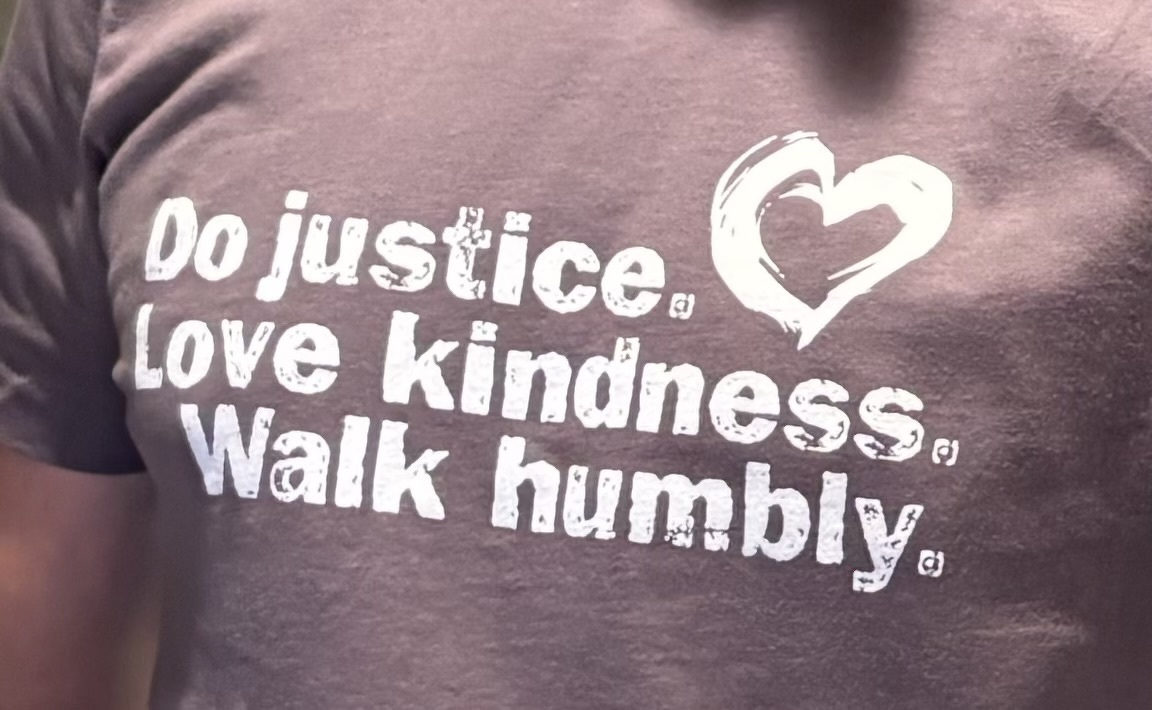
It just registered with me that the shirt I just bought left off the God part. I confess I feel a little disappointed about that.
friend:
I did notice that. And then I noticed that I actually like that. And then I spent some time pondering—feeling some shame for being negatively associated with bad theology/“Christians" and if it was more accessible to people reading it that might discount the text if they knew it was a Bible verse, but might open the door for conversation if they compliment the shirt, and if that was just my excuse/out for being hesitant to wear a “God” shirt these days.
me:
Good thoughts. The Micah 6:8 commands are intrinsically good with or without direct reference to God, so in that sense, it’s still a great shirt. Yet it does seem unnecessarily diffident. I think I’ve noticed a tendency in progressive Christian circles to leave overt God talk to the conservatives. And I think this is counterproductive. It creates a unwanted positive feedback loop: If the only Christians talking openly about Christ, the Bible, and God are racist homophobes and jingoistic conservatives, then the world won’t be able to help but reach the conclusion that Christians are racist homophobes and jingoistic conservatives. And the more the world thinks that, the more progressives will feel embarrassed to talk openly about Christ, the Bible, and God.
It is precisely a re-coupling of God language with virtue and justice language that we ought to be bringing.
friend
So true. And exactly my little introspective mind circular thought process.
“Love your neighbor as yourself.” I’ve always taken this to mean something like “regard and act toward those around you as if they and their good are as important to you as you and your good.” We can call that an equivalential reading. It’s probably a valid way to take it. But a passing remark in John Barclay’s Paul and the Power of Grace (that I’m having some difficulty re-finding so as to quote) has me thinking of another subtly but importantly different way of parsing it: “Regard and act toward those around you as if they and their good are you and your good.” We can call this a constitutive or even identificatory reading. I like it.
[edit, 7/8/26] Here’s the Barclay quote:
Love, then, does not mean self-sacrifice in the sense of negating oneself for the sake of others and expecting nothing back. The scriptural citation—“You should love your neighbor as yourself” (Leviticus 19:18, cited in Galatians 5:14)—could be understood in a number of ways, but it seems to include, not exclude, the self in the good that one shares with another in love (perhaps: “You should love your neighbor as if he/she were integral to yourself”). In other words, the self is not given away in love, but given into a relationship with others, a relationship in which all parties flourish“.
“Justice is patriotic,” intoned Bonnie Kline Smeltzer from the pulpit at University Baptist and Brethren Church today. I was this close to shouting “Amen!” I totally shoulda.
(It helped that she was wearing a one-of-a-kind, red-white-and-blue Free Subu button she had handmade last week. Appropriation of Old Glory for the sake of something good and having nothing to do with government authority or selling something is something I go in for.)
“Simply put, we long for Judgment Day because Judgment Day is good news.”
— Richard Beck, in harmony with the second half of my “I look forward to seeing You” sermon, which is itself a knowing echo of the third chapter of Dale Allison’s winsome, thoughtful Night Comes, entitled “Judgment and Partiality,” where he writes, “We’re not coherent when we applaud justice and jeer judgment.”
After this He then says to the disciples, “Let us go into Judaea again.” The disciples say, “Rabbi, the Judaeans were lately seeking to stone you, and you are going there again?” Jesus answered, “Are there not twelve hours in the day? If one walks by day, he will not stumble, because he sees the light of this cosmos, But if one walks by night, he stumbles, because the light is not in him” (John 11:7-10).
If love is calling, damn the fear of death. Full speed ahead. Do what is right.
“Rejoice always, pray without ceasing, in everything give thanks; for this is the will of God for you in Christ Jesus” (1 Thessalonians 5:16-18). There’s a synergy between these three commands. It’s easier to rejoice when you’re praying continually and giving thanks in everything; it’s easier to pray continually when you’re rejoicing always and giving thanks in everything (after all, to whom are we to give thanks for things like existence?); it’s easier to give thanks in everything when you’re rejoicing always and praying continually.
But all these require that you be here now and do what you’re doing, thinking not of other things.
“I would have to learn to live in a different way, seeing death as an imposing itinerant visitor but knowing that even if I’m dying, until I actually die, I am still living” (Paul Kalanithi, When Breath Becomes Air, emphasis mine). I want to carry this thought with me all the time as I age; it teaches me how to relate to others, all of whom will die someday, and how to relate to myself, who will also die someday.
“Pay close attention to yourself and to the teaching; persevere in these things, for as you do this you will save both yourself and those who hear you” (1 Timothy 4:16).
The only way this makes sense is if salvation is transformation by the renewing of your mind (and all that flows from that).
“Can forgiveness find a footing in broader systemic realities?”
“To encourage [Black people] to see their suffering as righteous obedience to God in Christ is to sanctify a perpetual social death.”
“In a moment of racial distress, forgiveness becomes a reflex response that serves the social maintenance of racial hierarchy.”
Some quick reflections: This is why forgiveness without amends is usually bad.
Potts is right that punishment and recompense will always be incommensurate with the wrongdoing (except for restitution, which can come close). That’s how you can say that forgiveness and justice can and do coexist: Forgiveness doesn’t say nothing is due; forgiveness says that what’s been paid is enough. Nothing more is due.
Just finished reading: “Forgiveness ≠ Reconciliation: Wisdom for Difficult Relationships” (2024) by Yana Jenay Conner, whose main idea is well summarized by the title. This was my favorite article in the Winter 2024 issue of Comment. Conner helped me realize that Matthew 18 contains a righteous unforgiveness: “And if he refuses to listen…let him be to you as a Gentile and a tax collector" (v. 17). And these two partial quotations struck me as beautiful: “I was a daddy’s girl without a dad…” and “Even if I was interested in adjusting my grip on the cross…”