Has prayer for relief from suffering for oneself ever been answered? I ask because I find it curious that all the testimonies of healings that I’ve heard all feature one person praying for another.
God could have just announced the gospel of Jesus Christ to the Gentile Himself, but He didn’t. But he commissioned Paul instead. Why?
God, You must decide not to answer some prayer, and it must be for a good reason. I can’t believe that You are so weak as to be thwarted in such a simple prayer as “God, please help me fall asleep,” or “God, please keep the bad dreams away,” or so mean as to callously turn a deaf ear to such a request. You decide to withhold for a reason. I think this happens more than the open theists allow. They overemphasize the success of those who thwart You.
I have recently decided to protest the apparently common atheist assertion that praying people pray only for those things that might happen without divine intervention anyway by praying for things I know God wants but that would also be impossible without Him.
Walking is one of my favorite activities. That means this afternoon made my happy: I not only got to walk the sheep pastures with God and sing snippets of Delirious? numbers to Him, but also got to walk from Sunset Park to Pattee Library to Rec Hall and back—about one mile each way—with Sullivan and Éa, who enjoyed seeing the sights and climbing things as much as I enjoyed watching them enjoy them.
An unfinished verse about the problem of divine hiddenness
O, invisible God, whom I cannot see,
Please, please reveal Yourself to me.
I don’t understand what you gain by hiding,
Blah-biddy blah, biddy-blah biddy fighting.
But I know You are love, if you are anything all,
Blah-biddy blah, biddy-blah biddy fall. ✏️ 🎤 🎵
Faith is a virtue inasmuch as its object is trustworthy. In the classical definition of God, then, it’s a pretty strong virtue.
And as for my requests recently to experience Him in a way that is inexplicable except by His intrusion, let me remind myself that with the miracles others around me have experienced, He has given me enough to go on.
This afternoon and evening were unhappy. It could be that I stayed up till a bit past 11 last night chitchatting with Carla in bed. But I think it’s more because I hewed too closely to my daily task list. More importantly, I didn’t hew very closely to You. There are times when I get “too efficient,” as Carla says, capturing task items very well but ignoring priorities, ignoring my heart, ignoring my desires, ignoring You. Why, today I could swear Carol requested my help in her remembering her frozen water bottle before she leaves tomorrow morning on her bus ride home because she saw that I am so robotically dedicated to my very reliable task list. But I’m a man, not a machine. I don’t ever want to lose my connection to You, or to the people around me. Let me be alive, not always working.
Maybe Watchman Nee is more correct that I thought, with his proposed dichotomy between living by the principle of right/wrong versus living by the principle of life. I still think it sounds too mystical.
The capsule reflection on that pamphlet that I posted to Goodreads: “I object strongly to the dichotomy introduced between decision-making based on right vs. wrong and making decisions based on “life,” whatever that is. Nevertheless, the pamphlet served as a reminder to me to not trust in my to-do list and trust instead that God is inside me, at work, and that referring to Him is the best way to make decisions.”
I was just praying through some of my “Favorites” I’ve marked via the new BibleGateway app, and it occurred to me: If I’m going to pray that I not be able to stop speaking about what I’ve seen and heard (Acts 4:20), I’m going to need to see something. The folks praying that prayer originally saw the Resurrection. I’ve seen nothing of the sort. So Lord, please give me or open my eyes to something to speak about!
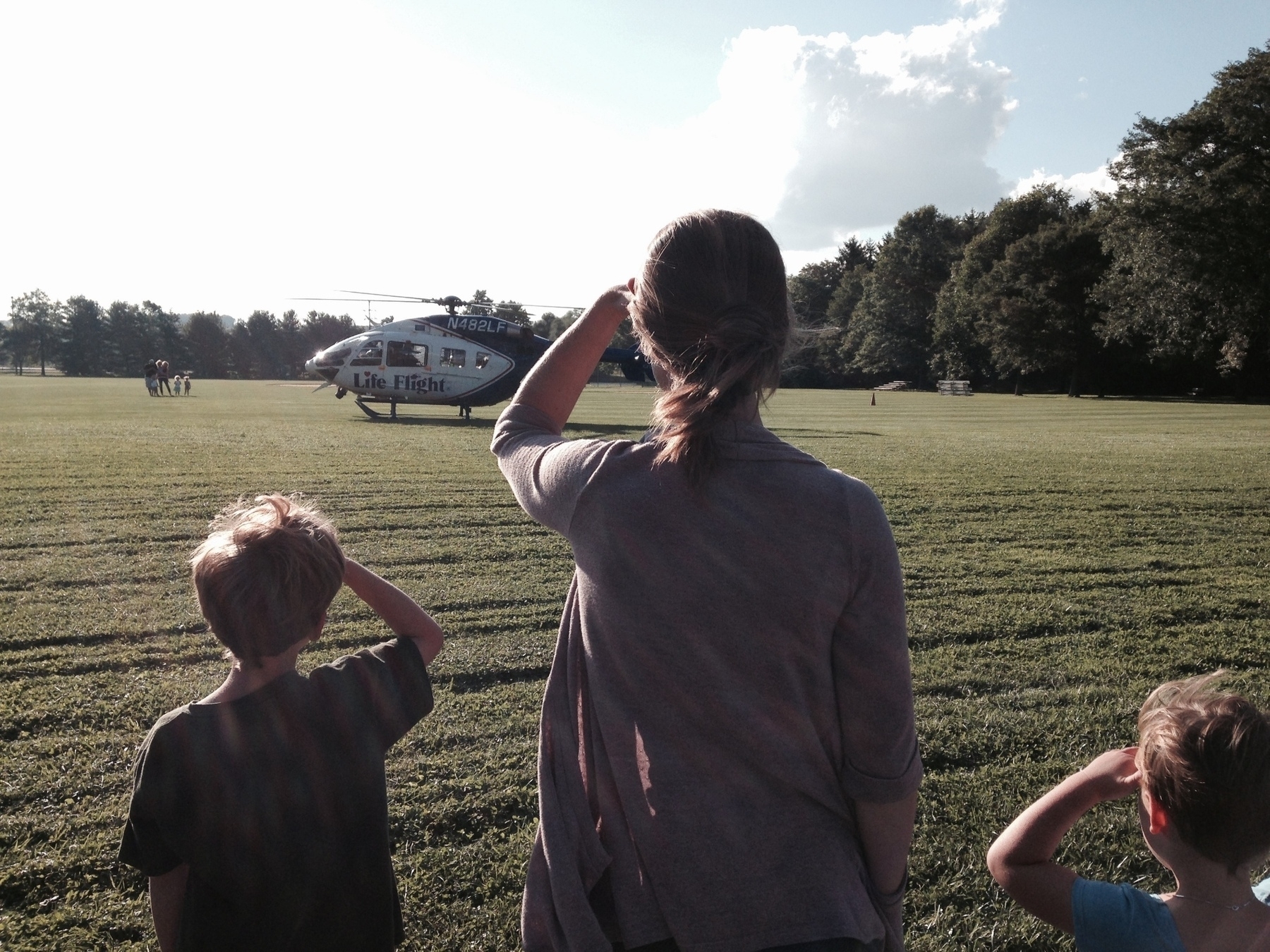
After an evening with the Houserville Social Club that included a LifeFlight helicopter takeoff, new friends Janine & Kimberly joining us at the table, Wengyi signing up for the email list, a game of cups (frickets) played heartily with Carla, Lara, and the kids, then more dowel/disc/cup fun with just the kids, I find further peace in my current station. I am a:
lover of God,
husband,
father,
brother,
son,
dilettante,
DiamondBack Truck Covers desk jockey,
church member,
neighbor,
community organizer,
someday adopter of children in need,
helper of the cause of the Gospel in the Maldives,
prayer warrior,
and patient, skilled, act-ive lover of anyone who happens to be around me at any time, regardless of socioeconomic class, IQ, or other human differentiator.
The list above is enough of an identity and set of pursuits to satisfy this hungry-for-meaning soul. I need do no other “great” things. If I fulfill my roles above with all my might (the specific, mutable ones subject to Your redirection), I shall be happy, and I shall not blink on Judgment Day.
More importantly, I shall no longer be subject to judge-and-second-guess-myself day, which used to happen, like, every day of my life but now wanes in frequency until it shall soon disappear completely.
And as for my doubts and questions, whether You are a restrictivist, an inclusivist, a universalist, or even a religious figment, my life will be best lived if I live it as though You are completely real. My prayer is that my doubts have three effects: More sympathy, less dogma, especially toward my children, and more action, since faith-as-action is much more important than faith-as-specific-credence to Inclusivist Yahweh, and Restrictivist Yahweh seems to prefer action as well.
“…nor do we know what to do, but our eyes are on You” (Jehoshaphat in 2 Chronicles 20:12). My, what a timely verse to pass on to Eric, who lost his job and has to decide what to do, and what a fine motto for any time like that.
“And seeing the man who had been healed standing with them, they had nothing to say in reply“ (Acts 4:14). Miracles silence Your opponents. That’s what makes their dearth so curious.
“Extraordinary claims require extraordinary evidence” is merely a more rhetorical way of saying, “I’ll believe it when I see it.”
Nevertheless, I do question whether incredulity toward an ancient miracle-claim is reason to withhold eternal life from those You love. If doubting Thomas gets a pass—[with a rebuke](John 20:24-29), I readily admit—why not the rest of us?
I’ve written it before: I am going to live my ordinary life in an extraordinary way: Rejoicing always, praying without ceasing, giving thanks in all circumstances, in humility of mind regarding those around me as more important than myself, loving You with all my heart, mind, soul and strength in my quotidian. I guarantee the non-quotidian will follow from there.
Good news for folks like me who sometimes worry whether Jesus’ instructions to the rich young ruler to sell 100% of what he owned and distribute it to the poor might be required of you to inherit eternal life per Luke 18:18-27: In the very next chapter, Jesus said Zaccheus was saved upon pledging just half.
I understand why trust is a virtue, particularly trust in the almighty creator. I don’t understand by it has to be just so blind, nor do I understand why it is the virtue on which salvation from death depends.
He’s Indonesian, Japanese, American, now Dutch.
Jimmy Hutasoit, we will miss you very much.
May you find a church with other folks who really really care.
Above it all, we pray, may you find Jesus Christ o’er there.