O Lord, by these things men live,
And in all these is the life of my spirit;
O restore me to health and let me live!
Lo, for my own welfare I had great bitterness;
It is You who has kept my soul from the pit of nothingness,
For You have cast all my sins behind Your back.
For Sheol cannot thank You,
Death cannot praise You;
Those who go down to the pit cannot hope for Your faithfulness.
It is the living who give thanks to You, as I do today;
A father tells his sons about Your faithfulness.
The Lord will surely save me;
So we will play my songs on stringed instruments
All the days of our life at the house of the Lord.
— Hezekiah, in Isaiah 38:16-20
I was touched by John Piper tweeting verse seventeen while I was doing nothing on the PestWorld show floor. What Hezekiah says about death, I could say about doubt.
Today I prayed for Todd, the young man at 535 Auto in Orlando who plugged my tire. The muscles controlling his right eye don’t work very well, rendering him virtually blind there since his birth. I handed him my business card and asked him to call me if anything happens.
I’ve seen all four, but only have the first three. I will be getting the Holy Ghost one on October 26th when they show it at the EastGate Philly Service. How’s your trip going?
me:
I ask about the movies for a specific reason: For the first time in my life, I have experienced religious doubt. It’s been acute, soul-threatening, and sleep-stealing. I think the momentum of my soul is in the right direction, but I’m certainly not out of the woods yet.
I’ll be traveling home solo much of the afternoon/evening Friday and morning/afternoon Saturday. Would you free for a longer phone chat sometime in those time windows?
Other than my doubt, we’ve had a great trip. The kids and Carla just touched down at BWI on their way home about an hour ago. Sullivan was apparently more excited about riding the airport tram, which was some kind of maglev or at least monorail, than he was about riding the plane. I’ll tell you more about it over the phone?
Mom:
Glad to hear the trip was a success. All believers struggle with this at times, including myself. Although, when it passes,I find myself even closer to God and my roots grounded even deeper. I’ll be praying and let’s definitely talk this Friday.
Last night was another sleepless one. And this time, I mostly kept the doubt and rumination at bay. It was a residual anxiety—that I still feel a bit sometimes even now—zapping my heart and traveling southward toward my bowels that kept me awake.
Whether He is a figment or not, I would be foolish to abandon God when He has been so good to me over the past twenty-five years. He has “worked” for me, so to speak. Why would I shun such a felicitous lodestar in the name of intellectual coherence? That would be to elevate reason above God, or at least to put Reason above pragmatism. I’d rather stick with What works.
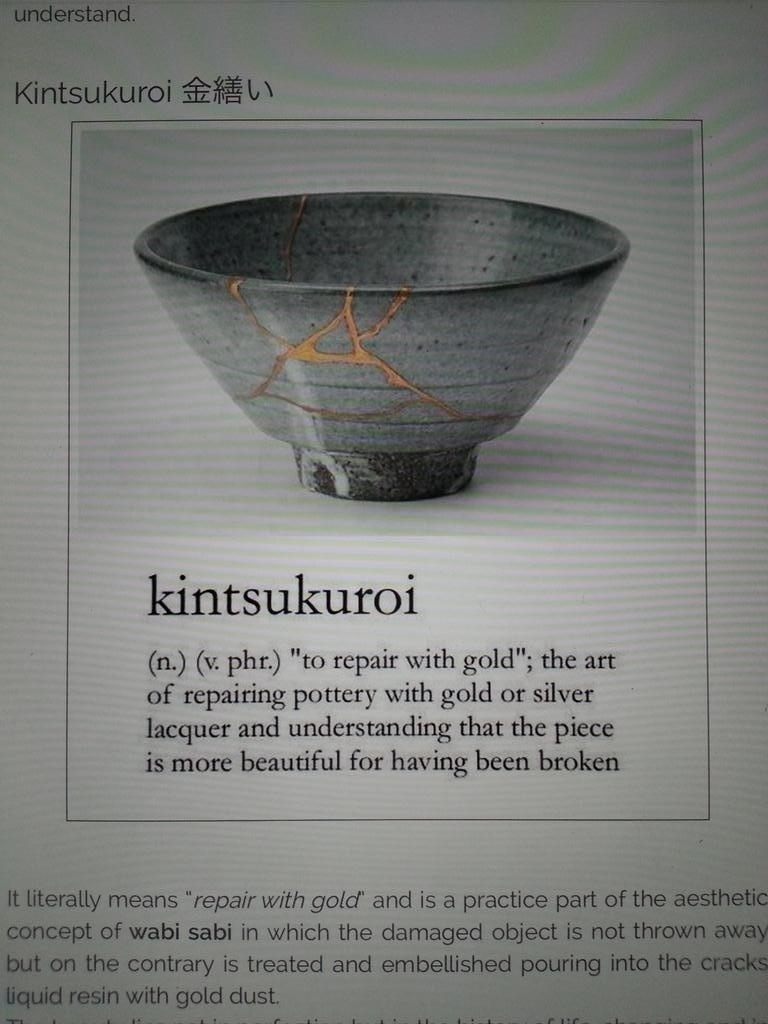
For perhaps the first time in my life, it feels like a metaphor like this might apply to me. Father, it is my prayer that my recent acute affliction of metaphysical doubt about You make me kintsukuroi.
I could either let the unanswerable theological questions win and spend the next five to ten years in likely miserable reorganization of my entire thought life, or I could settle for mystery.
This one shouldn’t be so hard. When did intellectual coherence become so important to me?
Religious doubt is beginning to be one of those things I need to write a long, well-considered entry about to help organize my thoughts for my own sake and for posterity.
In the absence of having made time to do so, here are another few bits:
The whole struggle comes down to this: Plausibility structures are very powerful. I can be thrown just by hearing an articulate person say he doesn’t believe in God. It has come to the point where I have considered and Carla has independently suggested we not get together for a sleepover with the Lundins again anytime soon.
I am now faced with two competing accounts: there is a God, and there isn’t. The latter hypothesis provides automatic resolution to all the heavy philosophical problems posed by theism. Want a satisfying end to your theodical questions? Just stop believing in God!
But the atheistic account also offers little in the way of explaining most of the supernatural phenomena I’m familiar with.
It is good to remember, especially with the specter of doubt still haunting my soul, that cogitation is terribly inefficient after bedtime. When tempted to mull in bed, don’t.
Have a philosophical problem? You’re not going to solve it lying in bed. So don’t try. Stuff it and go to sleep.
Not that I experienced this last night or anytime recently. But I might again someday soon.
Understanding creation as a war zone, with God having delegated to us the authority to fight, helps greatly to steel one’s faith and motivate one toward good works.
It’s too late to journal this in any detail, but suffice it to say for now that I’ve embraced that suffering and death is a part of everyone’s life. That’ll make me less fearful of death myself, less fearful for what my children will think in the wake of deaths and suffering around them, and more willing to take the risk of becoming a foster dad. Desiring God’s take on Romans 8 helps here. As does the whole Bible, which never once tells the saints they won’t suffer. It assumes suffering, and it assumes it as something to fight against, but also a backwards blessing as well, capable of creating much good character in someone.
This realization is a prayer answer to this morning’s prayer.
Hearing of some Christian acquaintances’ divorce today at church rattled me, especially after extended exposure to my unbelieving friends at last night’s family sleepover with them. I cried today in the sunroom to Carla that their divorce makes me ask, “What difference does Jesus make?” I mean, if the Gospel is not much more than “Jesus is God’s son, therefore God is like Jesus, whom He made king of the universe. And He promises some set of humanity the gift of eternal life,” then it’s still pretty good news, but my internal gospel has always included “glory to glory” and the effect eternal life has on us now. If there is no such thing and, say, the divorce rate among believing Christians is the same as it is among unbelievers, then I grieve the loss of what I thought was a piece of the Good News.
Now, Nas rapped “life’s a bitch and then you die.” And while I disagree with coda of his rhyme (“that’s why we get high”), it comforts me in the face of the above in the same way Ecclesiastes comforts me: “time and chance overtake them all” (Ecclesiastes 9:11b). The Bible basically admits that at some level, there will be no difference. Shit will happen to Christians and non-Christians alike. God intervenes in miraculous ways sparingly. An earthly life that is better than before, less seemingly random, and less prone to error is not a guarantee of becoming a Christian.
This also helps me appreciate the good fortune I currently enjoy, knowing that it is just that: good fortune. Many others do not share in my good fortune, and it is an in-built assignment to all who call on the name of Christ to relieve that suffering and do what we can to human flourishing.
I often put my hand over my heart when You and I go for strolls these days. I hope that means I love You, and not merely that I’ve adopted an affectation of loving You.
And you could always say: Well, I could have given that money to the missionary. And that is true. Every ice cream cone you buy you could have been sent to somewhere else. But I am thinking: Would you have? Has it gotten in the way of heartfelt calling to do a good thing?
The most significant thing today, other than the pumpkin carving all four of did in the kitchen while listening to a Béla Fleck collab folk album, photos of which I’m sure will be taken, is that I am concerned, although not to the point of taking any action, that I am overly distracted from Your kingdom, Lord, by nifty information tools. Today I updated f.lux, set up Day One to have two journal files, one for my journal and one for the record of days, relatedly cleared my Dropbox account, and got invited by the folks who build Remember the Milk to test out their upcoming overhaul. I got mildly excited about each. Is that OK?
Esprit d’escalier after a Spring-Creek-Park conversation about a friend’s experience with You, God, since a conference at Life Center back in February:
“Friend, I realize in retrospect that the reason for my muted reaction to your account of what God has done for you this past year was not jealousy or my own lack of similar experience: It was simply that what you were telling me was news Ethan has been sharing with me repeatedly since you encountered God so powerfully last February. I do remember rejoicing when I first heard the news. I praise God for it.
“It’s true that I don’t know what to say when speaking directly with someone describing an experience such as yours, because it’s true that I haven’t had much in the way of similar experience. But then, my heart is filled with peace and joy and light and has been—increasingly so—since my adolescence. Just because I’m not effervescent about Christ doesn’t mean I don’t love Him. I do always want to love Him with more of me, but I don’t need a powerful encounter to galvanize my love. Though to my limited understanding, it would be nice, for sure.
“On the subject of me finding it hard to get excited about the Gospel because I don’t understand it, perhaps an analogy will do: When you say Jesus showed His love for me when He allowed Himself to be executed by the Romans and Jews, I hear something akin to if Carla came to me and said, “Scott, I love you so much that I built an underground calliope that shoots chipmunks out of each pipe but only when you play in the key of B♭(my favorite key) so that when I want to see you and embrace, all I have to do is play a B♭ major chord to dispatch to chipmunks, who will run to tell you so.” If I don’t understand how you making an subterranean steam organ could mean ‘I love you,’ you won’t appreciate my love. If it doesn’t make sense, it doesn’t make heart. You can’t tell me to stop trying to understand it, I don’t think.”
“Christ redeemed us from the curse of the Law” (Galatians 3:13a).
Jesus be like, “S’alright. I got this.” And boom, with his execution, fulfills the requirements of the Law once and for all so that we don’t have to worry about it.
No, really. Paul writes that He bought us off a lender who was on our backs. You don’t need to do anything to inherit eternal life. He paid your ticket.
Carla and I sat through our first foster care preservice training class session this evening. I wasn’t surprised by anything the CYS folks said. It was heartening and entertaining to hear from the guest lecturing Pollock family, who have six kids right now. Carla and I thought we disagreed about whether we could proceed, but further conversation revealed that we agree: While she is on Council, we will stick with respite foster care only. She thought I wasn’t even OK with that; I had forgotten respite was all she wants to do at the moment.
The only other notable thing, besides the gratis Smartfood popcorn bags we snagged for the kids’ lunches tomorrow, was that I think every one of the candidates, plus the Pollocks, are motivated by their faith in Jesus Christ.
I need not fear the prospect of my children deciding against following Christ. It may happen. But it should not cause fear, apprehension, or anxiety. Sadness, yes, but even that the sadness of someone who can’t share a specific joy with someone else, not the sadness of a man robbed of his heart and soul. I will still be Christ’s, and Christ will still be mine. And the Christ I know these days doesn’t bar people from eternal life on the basis of their professions of specific faith, anyway.
But if I do experience such emotions, as yesterday after Carla pointed out that I answered a question Sullivan had not asked (Sullivan: “I wish the Lundins came to our church.” Me: “Well, they don’t go to church. Tom doesn’t believe in God.” Sullivan: “Really? He doesn’t believe in God?”), I need not be ashamed of them. It’s my shame about those feelings that causes me to clam up and act out rather than speak plainly about them.
“Paul wanted [Timothy] to go with him; and he took him and circumcised him because of the Jews who were in those parts, for they all knew that his father was a Greek” (Acts 16:3). Now that’s dedication.