This is what self-exhortation (in this case, to be a better listener) sometimes sounds like in my house.
“If you find honey, eat just what you need, lest you have your fill of it and throw it up” (Proverbs 25:16). Anything, even very pleasant things like musicmaking or music listening, can become noxious if too much.
What to say about today? Not much. I finished buying CDs for the year. It felt unfulfilling. Am I surprised? No. Does seem like I am systematizing the wrong things, or just spending so much time on things that definitely don’t have eternal significance. And yet I’m supposed to enjoy some honey, right? I’m supposed to enjoy. But that’s just it: I didn’t enjoy this. But isn’t there something about enjoyment with no Thanksgiving? And if I do not send money in the direction of the artist who’s recordings I enjoy so much, isn’t that being ungrateful? Anyway, one thing I know is always enjoyable: good conversation. I’m sure more of that’ll be coming up soon. Aaron K., Matt, Mark, Aaron G. Yahoo!
May you enjoy it
Even though I know you don’t enjoy it ✏️ 🎤 🎵
“The secret to faith is to have two loves: one for God and the other for whoever happens to be standing in front of you at any given time” (Eloy Cruz to Jimmy Carter, as quoted by Randall Balmer in The Christian Century).
Good job
Punjab
The curry’s really good ✏️ 🎤 🎵
Take a look around, see which way the whim blows ✏️ 🎤 🎵
Lisa asked me She asked me just the other day She said, “Tim, tell me what bothers you.” I said, “Huh, tell you what bothers me? I don’t think a whole lot about what bothers me.
| They say isn’t good to dwell on that. |
|---|
| But since you asked, |
| And since you’re a friend, |
| Let me think about what bothers me.” |
| —- |
| Lisa, I’ll tell you what bothers me, |
| What makes |
| Roadkill. |
| Roadkill. |
| Roadkill makes me curse the day |
| That Henry Ford |
| What the hell’s the matter with society |
| We drive roughshod every little thing |
| Acting like we own the place ✏️ 🎤 🎵 |
Note to self: If you accomplish anything non-DiamondBack in the evening of a DiamondBack workday, bravo to you.
“Do not strain to become rich; through your understanding, leave off” (Proverbs 23:4).
This is an experiment: Just record for five minutes whatever comes out of reflecting upon today. Today was a day when I was sick. A flu-like bug I probably caught from a Brannen at their Mimi’s house on Christmas Eve. I’m not sick very often. I don’t think I’ve been sick in a decade. (The upper back injury from the down-and-back chest press queue wasn’t sickness.) It was, as a result, a weird day, especially with Carla gone to visit her cousins to wish Kyle goodbye as he moves to Arizona. I finished Forgiveness: An Alternative Account and Watchmen. I cleared my sideboard drawer. I recorded a reply audio letter to Ruth, read about Josh’s surgery, and made a failed attempt to retrieve Éa Stratocaster from Mark Chaplin. I didn’t accomplish much. But that, I think was a gift, as any other member of my family will readily offer: In being slowed down by illness, I was required to take things easy. It would be no use to gear myself emotionally for an accomplishment-heavy day. Maybe I can take...
// read full article →Carla, man.
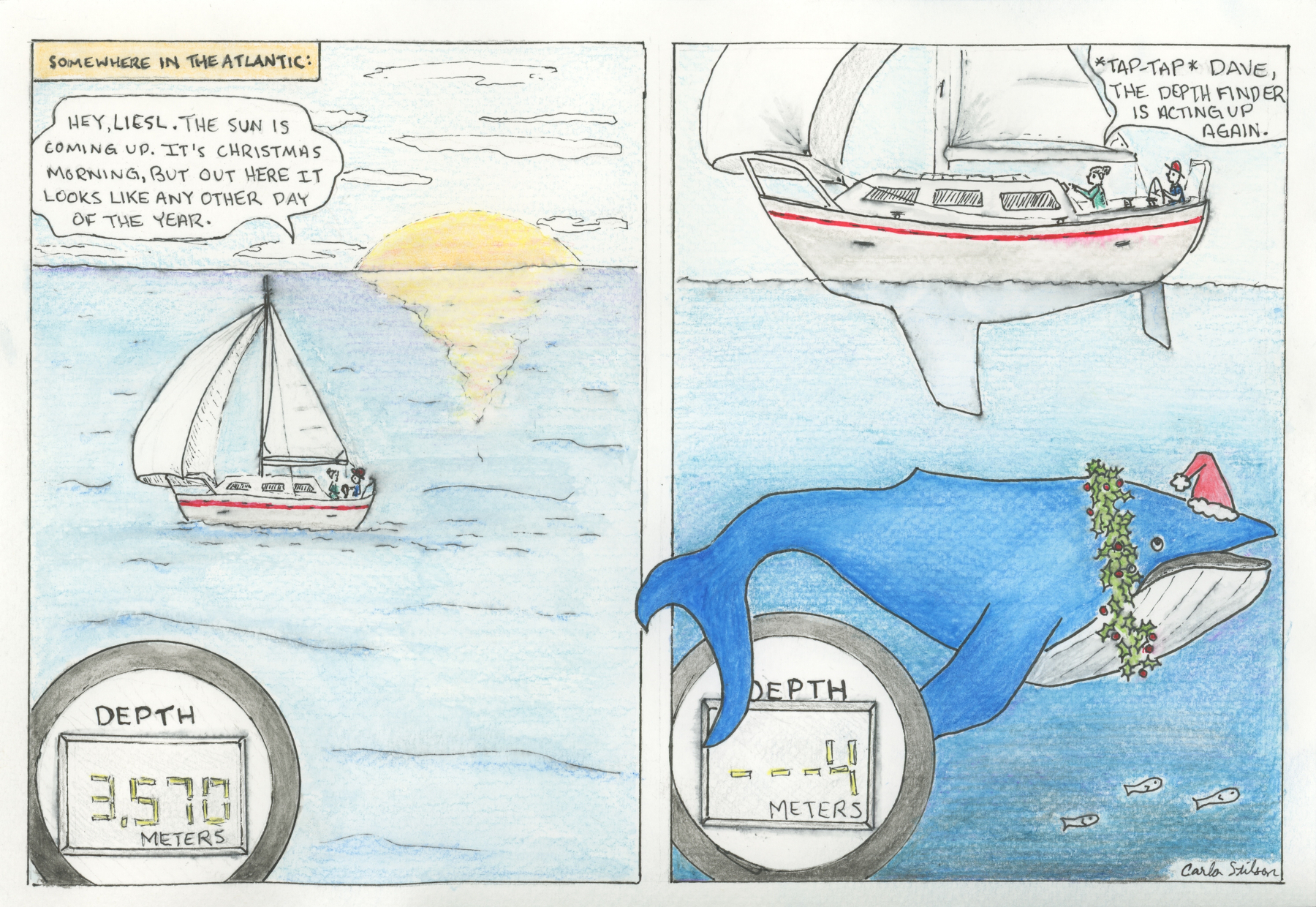
That’s a scan of a pen-and-watercolor cartoon she is sending to the captain of the sailboat she and her dad piloted this past summer from Bermuda to Connecticut.
When I’m deciding what to create next—and especially whether to write new music or spend time rehearsing music someone else has written—I can consider the cultivation of my own fruits of God’s spirit (peace and joy in particular) in addition to those of other people.
I’m pleased that this year’s listening added the following albums to my previous list of Christmas albums playable front to back both in the background or attentively:
- A Festival of Carols in Brass by The Philadelphia Brass Ensemble
- Wintersong by Sarah McLachlan
- Folkjul: A Swedish Folk Christmas by St. Jacob’s Chamber Choir, Gary Graden, Gunnar Idenstam, et al
Just re-listened to Merriweather Post Pavilion by Animal Collective (2009). I hesitate to recommend this wacked-out indietronica because like all the other Animaniac albums I’ve listened to, it’s easily heard as mere maelstrom of sophisticated-yet-juvenile, repetitive, acid-plus-coke freneticism. But on this one there’s just enough charm for me in the (still sophisticated-yet-juvenile, still repetitive) melodies, harmonies, syncopations, vocal timbres, and lyrics (often about family, which helps the charm) to overcome the hesitation.
Listen, Merriam-Webster: You descriptivists do good work. It’s important we have maps of the lay of our linguistic land as it lies. But don’t purport to explain to the world that prescriptivists are only interested in “‘correctness’ set forth in ‘rules’ that [we] imagine.” Just like poorly developed roads, a poorly designed language (as I concede every language is to some degree) sometimes leads to confusion, frustration, and hazards. To suggest prescriptivists are always wrong to do what they do is the equivalent of saying city planners are always wrong to do what they do.
Misdevelopment of the land has consequences. So it is with lexicons—especially when the words in question are of moral value. Consider “forgive.” If “forgive” is “actually used,” as you write, “by writers and speakers of the English language,” to include by definition reconciliation, forgetting, and anger abatement, which in some circles, although thankfully not quite in your dictionary, resentment being different...
// read full article →Inspired by part of this interview with Lisa Silvestri, the author of Peace by Peace: Risking Public Action, Creating Social Change, which I may read soonish with my friend Neill—after I finish:
- Forgiveness: An Alternative Account, which Ruth and I both got excited about roughly simultaneously and thus co-purchased (co-purchasing books—what a fun idea! an interpersonal nano-library…),
- parts of Stricken by God?, another of Neill’s recommendations after he read my essay about the Cross, and
- Watchmen, recommended to me by both my son and my wife—
here is a list of what bothers me:
- barriers to walkability,
- the predominance of solo, receptive, junky entertainment,
- words whose poor definitional boundaries cause moral problems,
- faulty exegesis,
- parroting, and
- roadkill.
Currently, there are only five Christmas albums I can listen to all the way through with pleasure:
- Banjo Christmas by The Clarke Family (sounds like what its title suggests)
- Merry Christmas by Mariah Carey (duh)
- Christmas With The New Black Eagle Jazz Band (Dixieland jazz)
- A Very Ping Pong Christmas by Shawn Lee’s Ping Pong Orchestra (charmingly jokey Stax pastiche)
- A Charlie Brown Christmas by Vince Guaraldi Trio (duh)
Buildings have walls
Only by necessity ✏️ 🎤 🎵
“All a man’s ways are pure in his eyes, but the LORD takes the spirit’s measure” (Proverbs 16:2). The first part isn’t true of everyone all the time. But it’s probably true of everyone some to most of the time. And certainly very often true of me. Lord, help us to discern.
If you feel compelled to do anything, then you are not free.
I cannot reliably control my circumstances. I cannot at all control other people. But I can control my (current) self. Herein lies happiness.
A truism, perhaps. But one worth repeating, especially to someone like myself who scores, mostly to his chagrin, as an 8 on the Enneagram.
Just re-listened to A King and His Kindness (2021) by Caroline Cobb. My favorite nuthin’-but-Jesus album since Rich Mullins’ 1997 demo tapes. Definitely square and very devout, hence the kind of album my enjoyment of which will lose me cool points with just about everyone I can think of. But these are the kinds of songs that make you not give a damn about cool points.
Proverbs also very frequently locates wisdom in how we receive correction.
Proverbs so often puts the locus of wisdom on what we say.