After an evening with Ben for the Roomful of Teeth concert at Schwab Auditorium, a lunchtime with Ernest yesterday, and a long campus walk with Mark last night, I reported to the Rookes that Carla says I abuse introverts. I hope it’s not true. Lord, may I be slow to speak.
Retiring for bed as soon as I could after the kids were in bed last night? The best decision I made all October (other than renting a bike in Seattle).
I must remember this every time I am tempted to press the 11 o’clock bedtime envelope.
Note to self: an increase in irrationality, peevishness, or moodiness that has no quickly identifiable cause is probably due to being some combination of undersexed and overtired. The end of Daylight Savings Time has wrecked me this week.
I am most comfortable in situations where I feel the superior. This is probably true of most people, but I noticed it this evening when my friend and his new squeeze came over with his sons at Sullivan’s request.
Would that I would take that comfort in my own skin with me in all social settings.
How shall I spend my spare attention these days, now that Noah and Dylan have gone home? On my family, I think.
I want include idle solitude in my life. I also want to read Richard Foster again.
I think it’ll just be simpler if I teetotal.
I am grateful for Sullivan’s ingenuity, which he displayed in rare simplicity yesterday when I decided—the sagacious father that I am—to ask him how he would secure to the roof the one length of droopy Christmas lights. He asked, simply, “Dad, what is our roof made out of?” “Steel,” I replied. “Oh! Just use some of our magnetic clips from the refrigerator!” Later that day, I did. And it worked well.
I am also thankful for Carla’s helpfulness, which she displayed when she wrapped the books I plan to give to Aniyah and Axton for Christmas without me asking her to do it. When someone swoops down to do something from my to-do list without me having to prompt it, it is very loving to me.
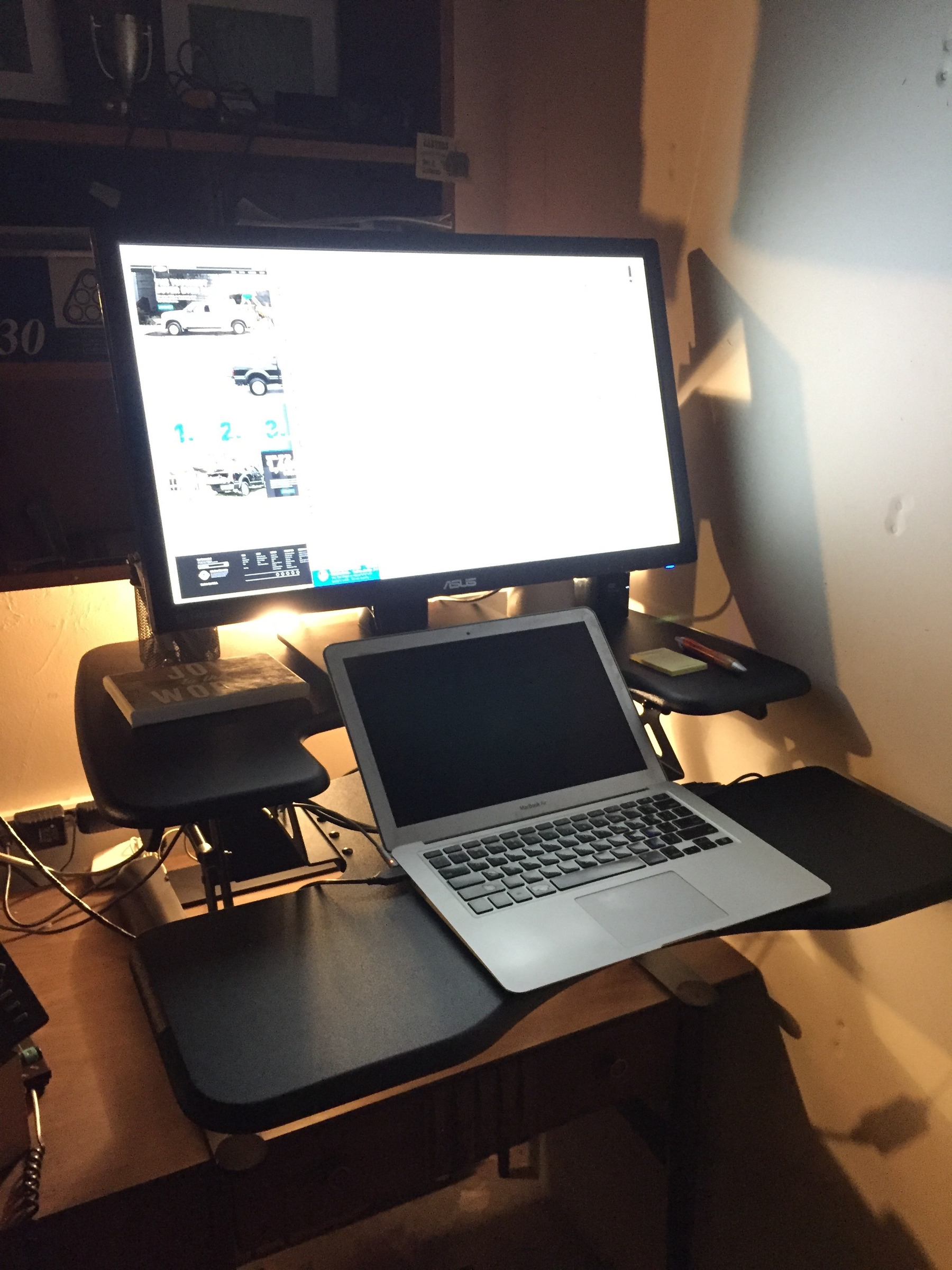
I set up my sit-stand desk this afternoon, courtesy of DiamondBack Truck Covers and Varidesk. Here’s to my long-term physical health. Now to get a standing mat.
Carla has been peevish recently. But so have I. It’s a cycle. I realized one way to break the cycle is to drop my expectation that anyone, including my wife and kids, act perfectly lovingly all the time. I don’t, so why should I expect them to?
I’ll go further: When a demand is made of me or a disagreement voiced, let my first instinct be to satisfy the demand or come to accord quickly and happily. Obviously, I won’t be a pushover, but I will be a volunteer, a happy second-miler.
Here’s an approachable, thorough article about easy measures you can take to extend the battery life of your iPhone between charges, courtesy of former Apple employee David Payette.
If, when I’m old, you were to ask me to tell you one thing about my life as it was today, I predict I’d tell you it was I day I think—I hope—I turned a corner in my character. You see, since screening the finale of the second season of Gatiss & Moffatt’s Sherlock this past Saturday, entitled “The Reichenbach Fall” (and probably a good bit before then), I had been obsessing over the show: obsessing about its plot, obsessing about its characters, obsessing about its actors, and obsessing about its writers. I was obsessing about my decision to stop watching it because of my obsession.
I needed to be rescued from all this.
And it’s more than Sherlock: In recent months, I have spent far too much time and attention setting up operating systems, selecting an iPhone case, and other such minutiae. I prioritize trivialities. And it robs me of life (and steals from DiamondBack).
We have overcome perfectionism. We have overcome stoniness. We have overcome self-distraction at work. We have overcome religious doubt. (All of the above are still works in progress, but they are works well on their way with clear paths to completion.) Perhaps now we can take on obsessiveness and the resulting misprioritization.
Deliberation, yes: You do that about problems and decisions. Cogitation, yes: You do that about profundities. Obsession, no: You do that, by definition, with things you ought not to. And I know what it feels like.
If you’re going to obsess about anything, do it about giving yourself for the benefit of other people.
Why do I assign standing priorities to all tasks in my to-do list, contra David “GTD” Allen’s advice? Because otherwise I would always choose that which is most easily checked off rather than what is most important.
This journal might as well be called “Scott tweaks his life.”
I thought of a good rule of thumb: I should set aside dinnertime to the kids’ bedtime not only as unstructured leisure time, but also as “spend as much time outside as possible” time.
If, in my old age, you asked me to tell you one thing about my life as it was today, I predict I’d tell you it was a day I had intended to go hear Paul McCartney play at the Bryce Jordan Center—his first and probably last concert in State College, PA—but had neither found someone to go buy scalped tickets with (Carla was at a Council meeting) nor communicated well with the babysitter, Molly Hunter, who wasn’t going to have a ride home. Top that off with a $475 bicycle maintenance bill earlier that day, and you get me canceling with the babysitter at 6:30 p.m. It helps that I’ve never cared much for arena concerts and that the babysitter had four big exams happening all the next day.
Such is life when you prioritize: Some things go neglected. And very often they are the things that should go neglected.
I wake up almost every morning these days with a shot of anxiety running through my middle. My inkling is that it stems from always doing and never resting. Is that it?
Carla says when she feels that way, she takes it as a prompt to pray.
Carla: Are you a thinker or a feeler?
Scott: Well, the facile response would be: duh, I’m a thinker. But I tend to think I’m actually a feeler who is articulate. Just not about feelings.
If you asked me in my old age to tell you one thing about my life as it was today, I’d tell you today was a day I realized that I’m not entirely pleased with the way I was governing my life. What I mean to say is that over the preceding few years the combination of Carla’s resistance to routinizing our relationship and my proclivity toward systems and routine has resulted in predictably relationship-free evenings: Carla curls up on the couch with her computer to watch a show, browse Facebook, and record the days, and I pursue my own agenda, usually on my computer as well.
(I speak in hyperbole that Carla would object to.)
What I was missing was a mindfulness of You that allowed me to transcend both my reliance on systems and enter sympathy, relatability, good listening, peace, and love. I resolved that day to, by God’s grace, no longer proceed through life with blinders on for getting things done, but to think of others, to enter into their skin, to respond lovingly, to allow room in my attention for impulses that are unrelated to accomplishment.
I resolve: On Sundays and holidays, I will rest from my agenda-fulfillment and I will not look at screens proactively.
Norman is going to try to schedule my private audition with Rich Biever for the part of Valjean for two weeks from today.
If this goes well—and really, for the quality of the audition itself—may I remember my words from a year ago:
It’s good to sing for my own enjoyment (or Yours, God), and it’s good to sing to delight someone else. But it’s unhealthy to sing to elicit praise.
Father, as I get deeper into singing performance in State College, please protect me from the intoxicating effects of people’s praise.
Five resolutions
I am going to:
- stop trying to queue up the next day’s tasks to fit into the time available to me and instead just keep a running list, believing that this will make it less likely that I obsess over my task list,
- proceed through my task list in the order I present it to my self, which will often mean that praying is the first thing I do,
- eat less and mostly greens for lunch,
- renew my commitment to eating no more than one helping at dinner, and
- stop fasting on Mondays and instead skip breakfast on Sundays.
I value browsing Twitter, but doing it during usual bathroom time first thing in the morning prevents me from getting outside and taking a walk with You, God. So I will save it for a break from my DiamondBack work instead.
If I’m not careful, I’m going to petrify a habit of mine that has developed in the past few weeks and become such a temptation as to displace the role seeking online infotainment or titillation has at times played in my life: reading theological articles on the Internet during the workday. If I allow this habit to solidify, it will have two detrimental effects: I will lose my job, and I will lose my faith.
Note to self: For as helpful as Richard Beck can be, I should read neither him nor his commenters before bed.