“The world is passing away along with its desires, but whoever does the will of God abides forever” (1 John 2:17).
I delight in assertions that eternal life is a real thing.
“The world is passing away along with its desires, but whoever does the will of God abides forever” (1 John 2:17).
I delight in assertions that eternal life is a real thing.
“You want it all, but you can’t have it.”
— Plato, as tweeted by Mike McHargue. Methinks it apocryphal and more likely a pop lyric. Nevertheless, I like it. Maybe he is summarizing Plato with a lyric.
“The Lord also will be a stronghold for the oppressed, a stronghold in times of trouble.”
— David, Psalm 9:9. A motto for foster care.
“The Lord has made Himself known.”
— David, Psalm 9:16. Would that it were that simple. But perhaps it is.
“I am going to judge my circumstances by Jesus’ love, not Jesus’ love by my circumstances.”
“For You are not a God who takes pleasure in wickedness; No evil dwells with You.”
— Psalm 5:4
I fail to comprehend how a theistic determinist, aka a Calvinist, can read this and say that God always predestines wicked behavior.
“I lay down and slept; I wakened again, for the Lord sustains me. I will not be afraid of ten thousands of people Who have set themselves against me round about.”
— Psalm 3:5-6
Reading through the Psalms is going to provide ample fodder for prayer—and encouragement and peace, I think, especially as I construe all the enemies involved as demons or anxieties or skeptics. Not that I will wish harm upon the skeptics as the psalmists wish about their enemies; but I will, as indicated in the above quotation, not be afraid of them.
“There would be no cults without the use of out-of-context proof-texts.”
How do good things in the ekklesia end up going bad? Often the road to corruption is paved with stones of well-intended pragmatism. Virtue is not always practical, nor profitable. Love is not pragmatic. There is no love column on a profit-loss statement or a balance sheet. Love cannot be analyzed. Love can be entered in to. Doing what is right does not always have an immediate practical outcome of benefit. When a spirit of pragmatism enters a community (especially regarding money) little incremental steps are taken choosing the practical and the profitable over the virtuous and honorable. Those little bricks of making pragmatism our God, pave the highway to corruption. Pragmatism wants to assure that a course of action turns out well for me/mine and ours. Love wants to make sure it turns out well for others, even if it costs me/us.
“When pride comes, then comes dishonor / But with the humble is wisdom.”
— Proverbs 11:2
“Your brain cannot do fear and gratitude simultaneously. If you’re in fear… go to a state of gratefulness” (Sue Krautkramer).
“Everywhere in the Bible you see God saying that his aim is his own glory, see love. For only this will satisfy our souls.”
And you could always say: Well, I could have given that money to the missionary. And that is true. Every ice cream cone you buy you could have been sent to somewhere else. But I am thinking: Would you have? Has it gotten in the way of heartfelt calling to do a good thing?
— John Piper, “What Luxuries in My Life Are Sinful?”
“The Lord gave me sixty-two years of joy and prosperity; will I curse him if the last five years are hard?”
— Eileen Anderson, Harps Unhung, xvii, as [quoted by John Piper]((https://twitter.com/johnpiper/status/519895769592393728)
“Christ redeemed us from the curse of the Law” (Galatians 3:13a).
Jesus be like, “S’alright. I got this.” And boom, with his execution, fulfills the requirements of the Law once and for all so that we don’t have to worry about it.
No, really. Paul writes that He bought us off a lender who was on our backs. You don’t need to do anything to inherit eternal life. He paid your ticket.
“Paul wanted [Timothy] to go with him; and he took him and circumcised him because of the Jews who were in those parts, for they all knew that his father was a Greek” (Acts 16:3). Now that’s dedication.
“Whatever you are, be a good one.”
— William Makepeace Thackeray, as quoted by Laurence Hutton as quoted by The Boston Herald, cited here in my journal with some emphasis on the “whatever” part
“And He made no distinction between us and them” (Acts 15:9a). May we who claim to follow Him follow suit.
“Who is there among you who is wise and intelligent? Then let him by his noble living show forth his [good] works with the [unobtrusive] humility [which is the proper attribute] of true wisdom…But the wisdom from above is first of all pure (undefiled); then it is peace-loving, courteous (considerate, gentle). [It is willing to] yield to reason, full of compassion and good fruits; it is wholehearted and straightforward, impartial and unfeigned (free from doubts, wavering, and insincerity). And the harvest of righteousness (of conformity to God’s will in thought and deed) is [the fruit of the seed] sown in peace by those who work for and make peace [in themselves and in others, that peace which means concord, agreement, and harmony between individuals, with undisturbedness, in a peaceful mind free from fears and agitating passions and moral conflicts]” (James 3:13,17-18, AMP).
Thank You, God, for reinforcing the lesson: If you think you’re wise, you’d better be able to prove it with deeds.
“When informed that someone has achieved an American synthesis of Led Zeppelin and Yes, all I can do is hold my ears and say gosh.”
— Robert Christgau, of Boston (1976), in a capsule review makes me laugh out loud
“Blessed are they who did not see, and yet believed” (Jesus, as reported in John 20:29).
I’ve always taken this saying of Jesus, along with several other beatitudes, as being some kind of moral judgment, in this case, that folks who trust Jesus without having to see Him are better people than those who need to see Him to believe. But that’s not what He is saying: Instead, it’s that the more credulous among us are happier, to be envied, as the Amplified Bible puts it. It’s true: If I didn’t feel impelled to study and intellectualize and apologize God, I’d be a much happier man.
Acts 26:8 is a phrase that contains the heart of the problems of using a Bayesian probability approach to the question of the Resurrection: “Why is it considered incredible among you people if God does raise the dead?” In other words, if you’re a theist, it isn’t that hard to believe in a resurrection. If you’re an atheist, then yes, obviously, it’s, um, unlikely, to say the least.
Consider it all joy, my brethren, when you encounter various trials, knowing that the testing of your faith produces endurance. And let endurance have its perfect result, so that you may be perfect and complete, lacking in nothing (James 1:2-4).
and
Blessed be the God and Father of our Lord Jesus Christ, who according to His great mercy has caused us to be born again to a living hope through the resurrection of Jesus Christ from the dead, to obtain an inheritance which is imperishable and undefiled and will not fade away, reserved in heaven for you, who are protected by the power of God through faith for a salvation ready to be revealed in the last time. In this you greatly rejoice, even though now for a little while, if necessary, you have been distressed by various trials, so that the proof of your faith, being more precious than gold which is perishable, even though tested by fire, may be found to result in praise and glory and honor at the revelation of Jesus Christ; and though you have not seen Him, you love Him, and though you do not see Him now, but believe in Him, you greatly rejoice with joy inexpressible and full of glory, obtaining as the outcome of your faith the salvation of your souls (1 Peter 1:3-9).
Hardship appears to be what New Testament writers have in mind when they talk about trials, tribulations, and endurance. But what about doubt in the face of rational critique? Could that count? Should I, easy-life white man, take these verses and those like it as my own?
Also, the Bible writers have this strange idea that trials bring perseverance rather than challenging it.
A simple experiment in making friends (and thus a community): Let’s gather for a potluck dinner on the second and fourth Thursday evenings of each month.
Open to anyone living in Houserville, Bathgate Springs, Clover Highlands—anyone at all, really, but intended for folks for whom, say, Spring Creek Park is a walkable destination.
“What should young people do with their lives today? Many things, obviously. But the most daring thing is to create stable communities in which the terrible disease of loneliness can be cured” (Kurt Vonnegut).
This write-up of mine describing the Houserville Social Club on the potluck sign-up sheet on SignUp Genius and the accompanying Vonnegut quote has taken on increasing value in my life recently. As if it really is my mission. Maybe it’s Robin Williams’ death and the admissions of depression that are being published everywhere in its wake that has helped galvanize it.
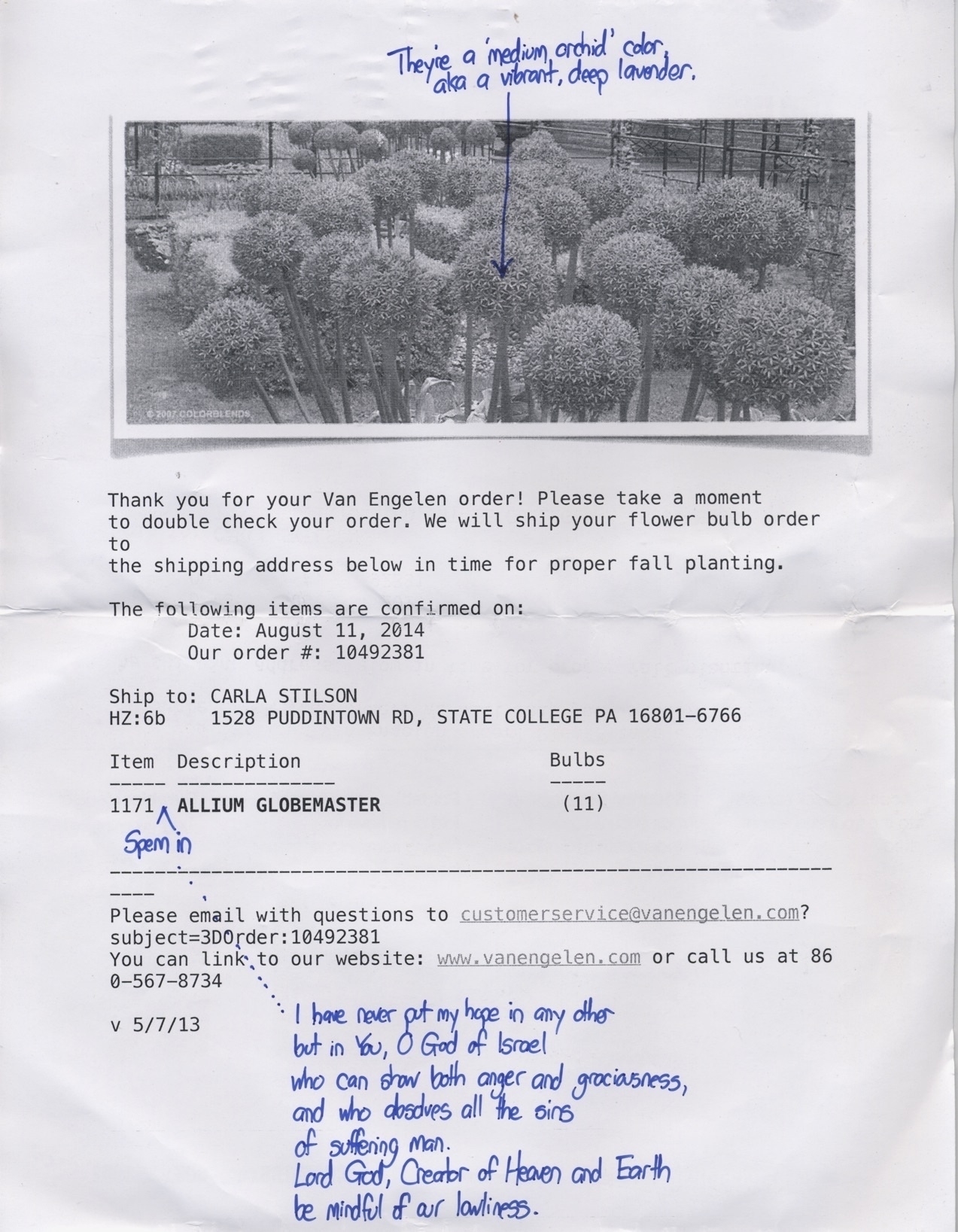
I bought Carla some flowers today. Consider it an improvement on the one cut rose per year we’ve been married.