I am grateful for a possibly newfound ability to mourn, which I did with Carla tonight when she got a call from Carole saying that the doctors at Geisinger don’t expect Janet to live through the night. It felt good to cry. Faced with death, don’t attempt to console. Simply mourn alongside people. And then when they lose someone, as Janet’s family is about to, help a lot.
Alright, enough Scott-resolution and navel gazing. I am grateful for Janet. She brought gifts for our kids (and sometimes for us) almost every conceivable holiday. She joked a lot. She showed us the value of being friends with your neighbors.
That’s all I want to journal about tonight. Janet’s imminent death overshadows everything else.
love noun1 Self-donation (e.g., of attention, energy, time, material resources, money) for the good of another, ideally driven by affection, and if not that, then by principled regard for others as at least as important as oneself
When we say “I love you” to someone, we mean that we desire to love them as above.
I am grateful for the opportunity to help Janet in her time of need. But I want need not to be! Carla has visited a few times over the past several days because Janet has been loopy because of some medication she is one in connection with her perma-asthma that set in this winter like last. Apparently, MRIs at the hospital today may have revealed lymphoma.
I am grateful for the resilience and emotional maturity Éa displayed upon getting her ears pierced at Ikonic Ink downtown today. It hurt, but she displayed (and was multiply congratulated by onlookers for) stoicism while Miranda the “piercing artist” was doing her work. When it was done, she cried honest, quite-but-unashamed tears in Mommy’s arms. May all my children know what to do with their sadness and pain.
And may more families make family outings at tattoo and piercing parlors?
I will eat game mammals because they are not as ecologically expensive. Plus, by hunting myself, I am staying more in touch with what eating mammals entails for the mammals.
Hanging out with people is the only way to save the poor in spirit. Do I remember the two wall-to-wall days I spent with Uncle Chris? What a joy, and it touched his soul. It’s the only way—at least, the only way conceivable for me—for people like him and César to make their way out of moral and circumstantial poverty. But what am I to do? If I were a single man, I think I’d keep my job at DiamondBack and take it with me as I went on medium-term mission trips to live with César in Callao and with anyone I met who was a pariah, and I would hang out with them.
Carla has been peevish recently. But so have I. It’s a cycle. I realized one way to break the cycle is to drop my expectation that anyone, including my wife and kids, act perfectly lovingly all the time. I don’t, so why should I expect them to?
I’ll go further: When a demand is made of me or a disagreement voiced, let my first instinct be to satisfy the demand or come to accord quickly and happily. Obviously, I won’t be a pushover, but I will be a volunteer, a happy second-miler.
As this first day of my sprint toward getting a minimum viable website up for Frank and PolyGreen America ends, I am reminded that hobbies are happiest when they are not only enjoyable, but also seen as a form of generosity. In the case of web-development-on-the-side-that-disturbs-my-schedule-equilibirum, the enjoyment is possible only when I view it as such.
So Lord, let me renew that vantage on this work—and all work, really.
If, when I’m old, you were to ask me to tell you one thing about my life as it was today, I predict I’d tell you it was I day I think—I hope—I turned a corner in my character. You see, since screening the finale of the second season of Gatiss & Moffatt’s Sherlock this past Saturday, entitled “The Reichenbach Fall” (and probably a good bit before then), I had been obsessing over the show: obsessing about its plot, obsessing about its characters, obsessing about its actors, and obsessing about its writers. I was obsessing about my decision to stop watching it because of my obsession.
I needed to be rescued from all this.
And it’s more than Sherlock: In recent months, I have spent far too much time and attention setting up operating systems, selecting an iPhone case, and other such minutiae. I prioritize trivialities. And it robs me of life (and steals from DiamondBack).
We have overcome perfectionism. We have overcome stoniness. We have overcome self-distraction at work. We have overcome religious doubt. (All of the above are still works in progress, but they are works well on their way with clear paths to completion.) Perhaps now we can take on obsessiveness and the resulting misprioritization.
Deliberation, yes: You do that about problems and decisions. Cogitation, yes: You do that about profundities. Obsession, no: You do that, by definition, with things you ought not to. And I know what it feels like.
If you’re going to obsess about anything, do it about giving yourself for the benefit of other people.
If, when I’m old, you were to ask me to tell you one thing about my life as it was today, I predict I’d tell you we had our 72-year-old next-door neighbor Janet Donald over for leftover Stilson rotini dinner, homemade quick bread, a thirteen-year-old shiraz Janet had donated to us a month prior for Carla’s birthday, and some after-dinner Dixit at the kids’ prompting, all while piano jazz played on Spotify and the thermostat was set to a balmy 67°F.
I told her I love having her over.
Did I say it because I love the feeling of moral pride it gives me to know I have my aged next-door neighbor over for dinner and counter her as a friend? In part, yes. But I also said it because I really do like her.
As I read these healing stories from gate A22 a few minutes ahead of boarding for Las Vegas, it occurs to me that there is a singular inner focus I can carry in life that will make for healing prayers and acts of mercy and friendliness and whatever good and God I can do: keep the foot washing in mind.
If you asked me in my old age to tell you one thing about my life as it was today, I’d tell you it was a day we had our 71-year-old neighbor Janet Donald join us for chicken pot pie dinner. It wasn’t the first time we’d had her over for dinner; it was probably about the twelfth. But this time, as we enjoyed her company, I thought once or twice about how she, being seventy-one years old, will likely die while Sullivan and Éa, how she’d probably beat Carol, Sully, and my dad to death’s door and thus be the closest person yet to our kids to die when that time comes.
What benefit, these thoughts? Not much. Except to say I hope to fill our days in part with loving Janet well in her twilight years.
— Andrew Shearman, as reported by Ethan, with whom a visiting Jason and I sat with at Happy Valley Brewing and discussed many things, including, but this topic of how to govern and steer one’s life being the most salient and edifying. I rephrased Shearman’s idea in a way that was helpful to both my friends: “Unless you have a specific calling—which you’ll know when you feel it—whether you move to Cambodia to end sex slavery or stay here and love people well, you can’t go wrong as long as you love God.”
I woke up Sunday morning with Max von Sydow’s name in my head and an inkling that this name might be a hint from God. All I remembered upon waking was that he was an actor or a director. On Wikipedia that morning I discovered he played the knight in The Seventh Seal, Jesus in The Greatest Story Every Told, the villian in Minority Report, and Karl-Oskar in Troell’s 1971 film adaptation of Moberg’s The Emigrants. I read no further in the Wikipedia entry because I felt the reason I was to be thinking about von Sydow was contained in this opening paragraph’s list of his most notable movies.
I wasn’t sure at first what God might be getting at and asked Him to clarify which film was of interest to Him. It became clear upon further reflection: It was The Emigrants. Carla has recently enjoyed three of the four novels in that series and often talks of how she wishes I could read the books she reads so we could share in them. And I had just the other night and several recent nights before asked God to restore the love between us and help me to love Carla well. Watching the film adaptation of these novels that Carla so appreciated with her would be a away to proactively, creatively love her.
So I set to finding a copy. All I found were a few VHS copies in a libraries across the Commonwealth. But later that morning I opened one of the blue desk/TV stand drawers looking for software for Éa’s new keyboard and found along with the CD-ROM I sought a pair of DVD-Rs that Greta had given us for Christmas that contained The Emigrants and The New Land!
Could Greta have mentioned von Sydow’s name upon presenting the gift to us a few weeks ago and my subconscious mind surfaced it on its own, either in self-answer to my prayer or totally randomly? Yes. Do nonetheless I believe that it was the Holy Spirit giving Carla and me—especially me—a little gift in answer to my prayers about loving Carla and about Him talking to me and making Himself more real to me? Yes.
Saw this testimony on Youtube. I thought it would be worth your time to watch it. You only need to watch the first 13 minutes of it.
me:
Thanks, Mom! I’ve queued it up for later watching.
I’m concluding, however, that being assiduous about answering my questions and shoring up my faith isn’t healthy. There appears to be a positive correlation between the sedulity with which I approach my questions and the likelihood that my reading and watching will deepen my doubts.
In other words, I’m finding it much healthier and more likely to lead to restored strength of belief to take this whole thing slowly.
But by all means, if you come across other resources you think would be helpful, I’m very good at queueing things up for reading or watching and then following through with reading or watching them later. I’ve just about finished Surprised by Joy, which you graciously sent me last month. Thanks again for that.
Mom:
Sedulity - I had to look that one up. Great word. I think I understand what you’re saying.
I would have sent you the video link regardless, as it’s such a great testimony! (as well as 2 others, but I didn’t want to send too much). Yet there’s something about a radically changed life that’s hard to argue with.
There will always be unanswered questions. For most, I think it gets down to ‘you see what you believe’ - you can choose to see God in everything and you will or you can choose not to see Him, and you won’t and you’ll find ‘proof’ that he doesn’t exist. I can see God in a snowflake or an orchid or a colorful sunset. I can hear Him in the ocean, the breeze, or the birds singing. I can sense His pleasure and joy when I do something nice for someone, or just hang out with Him. It’s fun; it’s wonderful; it’s full of hope and peace. I wouldn’t trade it for anything.
Now faith is the assurance of things hoped for, the conviction of things not seen.
My relationship with God is based on my love for Him and His awesome love for me in soooo many ways. I haven’t heard you mention anything about loving God? Just wondering where you’re at with that?
Was ‘Surprised by Joy’ a good book? I’m praying that He surprises you. :)
Much love and can’t wait to see you all soon!
“The heavens declare the glory of God; the skies proclaim the work of his hands. Day after day they pour forth speech; night after night they reveal knowledge. They have no speech, they use no words; no sound is heard from them. Yet their voice goes out into all the earth, their words to the ends of the world… " Psalm 19:1-4a
me:
I’m 3/4 of the way through Surprised by Joy and Lewis has yet take his turn toward theism. So the book has been occasionally interesting, but mostly a semi-dry memoir of his childhood and youth. Still, a worthwhile read that’s much less heady than some stuff he wrote.
I’m praying He surprise me, too.
Psalms are very helpful, although the psalm you quote has at times been a source of anxiety, as sometimes in the past several months when I look at the skies, I don’t hear them declaring His glory, and that has worried me.
I do love God. That’s why the prospect of losing Him to has been so anxiety-ridden.
But since part of loving Him is pleasing Him, and the writer of Hebrews says that it’s impossible to please Him without faith (v. 6), and that to come to Him I must believe that He is and that He is a rewarder of those who seek Him, I do feel like I’m making a turn toward a firm decision to believe and stay put, as in a marriage. Even if my seeking of Him isn’t leading to the promised reward in the timing or way I prefer, it is still leading there. If I’ll only hold on.
Like I said, keep sending me whatever you want to send me. (You’re right that it’s hard to argue about a radically changed life.) Just know that I won’t necessarily read, watch, or listen to it right away.
The thing for which I’m most I’m most grateful—to whom? perhaps I should start saying ‘appreciative’ instead—on this doubtful day is that I remembered that, as it regards the afterlife as well as how to live this life, it doesn’t matter whether God is real. Will the reality or unreality of the afterlife the way I live change? The way I talk about metaphysics will, certainly. But lifestyle? I don’t think so. Either way, I’m going to live well, i.e., love well. Actually, in my mind at this moment, I’d even consider it possible that I’d live better without the idea that I will live forever. One life to live means only one life to give.
“If I had to distill it to one issue, I would say it’s that the visible church seems to care more about ideas than people.”
— Derek Webb, in reply to “Is there one thing you see as the biggest issue/blind spot for the church, an area where Christianity is failing to live up to its promise and purpose?” on Rachel Held Evans’ blog
In context, Webb is talking about Christians letting disagreement trump relationships. In true reader-reception form, his offering is broader and more convicting: I care more about having the right ideas than I do about actively loving people. Christianity is less about about having good theology and more about acting like Christ.
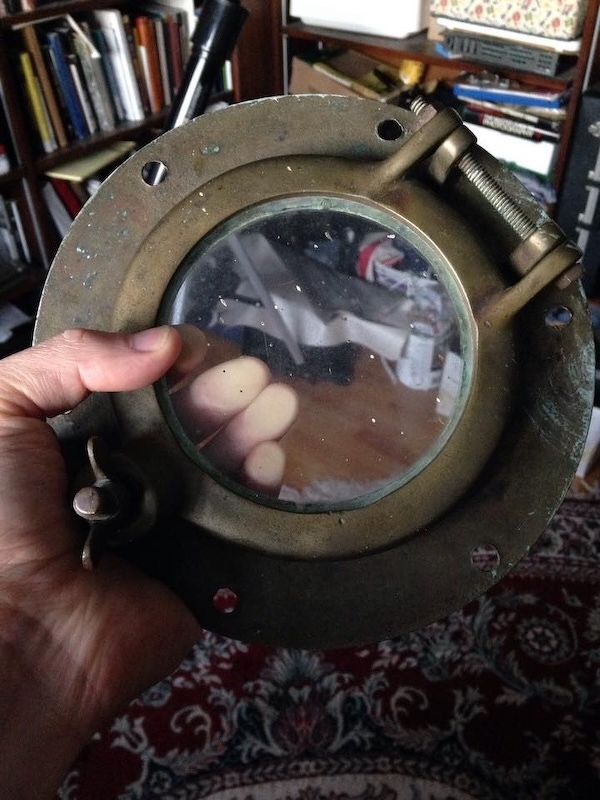
That porthole has taken on new meaning: Friends. It gratifies me to no end to contemplate how faithful my friends were to me. How when I needed them (Carla, Sullivan, Janet, the Rookes), they were there. My physical suffering, like my doubt-borne anguish last month, becomes a reason for thanksgiving: I have friends who love me.
A call-and-response greeting for Thanksgiving that came out of a brief SMS exchange with Daniel Perea today in which he expressed confusion about what greeting to give on Thanksgiving: “Give thanks to the Lord / for He is good / and His love endures forever.”
How do good things in the ekklesia end up going bad? Often the road to corruption is paved with stones of well-intended pragmatism. Virtue is not always practical, nor profitable. Love is not pragmatic. There is no love column on a profit-loss statement or a balance sheet. Love cannot be analyzed. Love can be entered in to. Doing what is right does not always have an immediate practical outcome of benefit. When a spirit of pragmatism enters a community (especially regarding money) little incremental steps are taken choosing the practical and the profitable over the virtuous and honorable. Those little bricks of making pragmatism our God, pave the highway to corruption. Pragmatism wants to assure that a course of action turns out well for me/mine and ours. Love wants to make sure it turns out well for others, even if it costs me/us.