Clinging to a Man who is no longer perceptibly with us is not a sufficient ethic, as the very fact that we have the term “aberrational Christian or Bible-based groups” attests. It’s too loosy-goosey. People can make stuff up about what He is saying. Therefore, we must hermeneutically extract principles from His biographies.
Completism is not a fruit of the spirit.
I shall not be ashamed of saying God healed the people I read about or that God spoke to Carla about such-and-such. I may have to fall back on one of McHargue’s maxims, but still. It’s better than shying away from calling it God. And I need You, God. It used to be a luxury I was requesting; now it is a necessity. I need to experience You. I can point to my good life and say You gave them to me, but that’s not the same thing.
On God
#Personifying the highest good is very motivating, even if it’s false (which I don’t think it is, but it might be).
I wake up almost every morning these days with a shot of anxiety running through my middle. My inkling is that it stems from always doing and never resting. Is that it?
Carla says when she feels that way, she takes it as a prompt to pray.
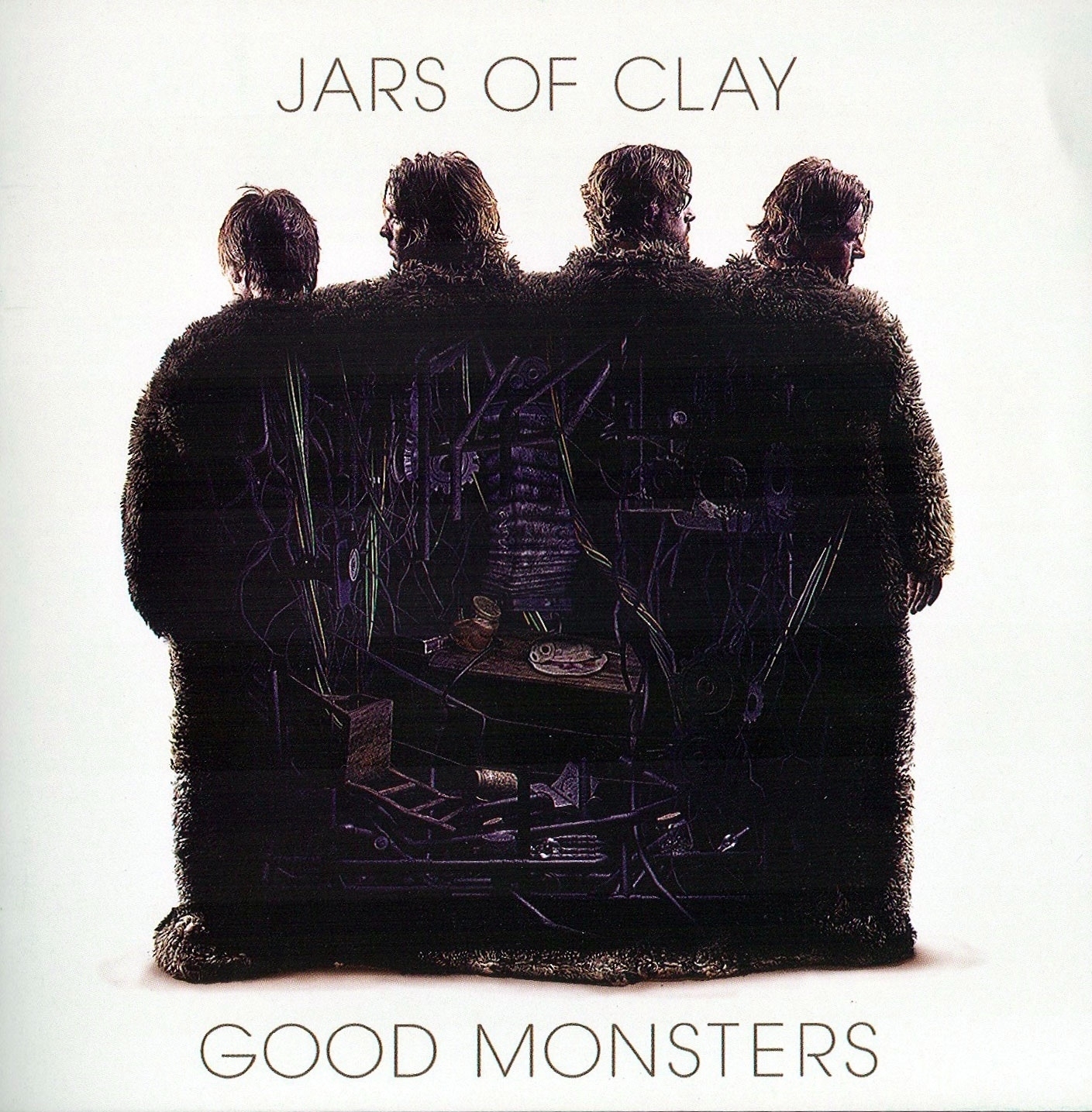
There’s plenty of high-quality Christian music out there. Why not spin it more often? Listening to a few Jars and Crowder tracks this evening reminds me that I need not be shy.
If you asked me in my old age to tell you one thing about my life as it was today, I’d tell you that it was a day I remembered that chills had suggested back in January that I start building a habit of singing new songs to God.
As I revisited Psalm 33, where I had found the chills about singing new songs and becoming skilled at making music to You, I found some other new things:
- “No king is saved by the great size and power of his army; a mighty man is not delivered by much strength. A horse is devoid of value for victory; neither does he deliver any by his great power,” i.e., I’m not going to find salvation by having the whole Internet at my disposal, and it’s not the heaviest intellects that get God. So give it up.
- “Let Your mercy and loving-kindness, O Lord, be upon us, in proportion to our waiting and hoping for You”—uh oh, I haven’t been setting my hope on You, now, God, now have I? I felt a little ashamed.
As I read these healing stories from gate A22 a few minutes ahead of boarding for Las Vegas, it occurs to me that there is a singular inner focus I can carry in life that will make for healing prayers and acts of mercy and friendliness and whatever good and God I can do: keep the foot washing in mind.
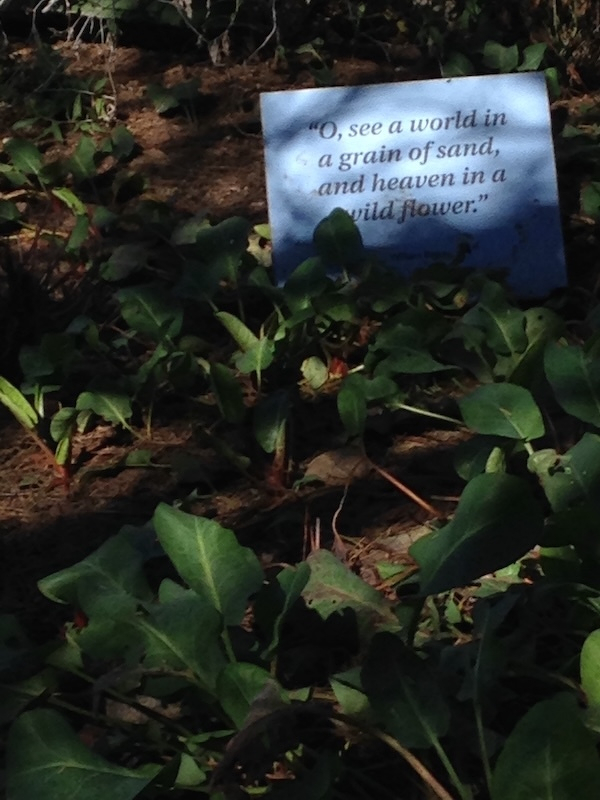
These are the first four lines of William Blake’s “Auguries of Innocence” (1803). I encountered them at the Desert Botanical Gardens on solo mini-spur stroll while visiting with Jessica and Brooklyn. I take it as an exhortation to view God not only in the supernatural, but also in the natural.
If you asked me in my old age to tell you one thing about my life as it was today, I’d tell you that it was a day that featured an evening in which I struggled to understand how I am to know firsthand that God is loving and faithful as David writes if I can’t sense Him. And then I remembered: He works in me to will and to act according to His good pleasure. He is at work and He is good and He will even bring us from glory to glory, as I used to repeat in years past. Even if I can’t see Him, He is at work in me and in the world.
It was also a day when I spent most of my workday—and therefore a good chunk of vacation time—applying my very slow, barely conscious financial brain to hashing out nuances in the way we handle our finances. All so that I could figure out what to do when my parents give money toward the kids’ long-term or college savings and so that I could give Carla a better idea of what balances we can expect in our various savings accounts at the end of the year. It was an example of being unhealthily carried away from my regular agenda, I think. Plus, money is definitely deceitful.
Dad! In heaven, I bet that don’t have any rifles.
— Sullivan, without prompting, while being towed along through Spring Creek Park on a snow saucer
Attributing the healing miracles I’m reading about in Eric Metaxas’ Miracles to rare, poorly understood, completely undivine, powerful psychosomatics because one has to avoid confirmation bias is like remaining agnostic about the origin of a love letter left for me in Carla’s handwriting with her signature on it. If it’s in her handwriting and name, it’s rational to conclude that she wrote it. Similarly, if these miracles happened in the name of Jesus, it’s rational to conclude that Jesus did them. Is it possible that some purely natural, impersonal set of biological and psychological forces combined to make these healings happen? Yes, just like it’s possible that I forged the hypothetical love letter subconsciously out of a desire to be loved by Carla. Do I have any explanatory mechanism that is more powerful than to attribute the healings to God and the love letter to Carla? No, not even close. Does it seem overly skeptical to withhold conclusions about the origin of a miracle when it happens in Jesus’ name and has no great natural explanation because science might someday understand what is happening? In many cases, such as in the cases of these stories, yes.
If you asked me in my old age to tell you one thing about my life as it was today, I’d tell you three, which I’d be allowed to do because they’re all related and happened within the same twenty-minute period at bedtime:
- I read several stories from Love Letters From God, a recent gift from my mother, to Sullivan and Éa freely by their request and without trepidation, demonstrating and substantiating that I was not as apprehensive about talking about God with them as I had been in the recent past because of my doubt,
- I was unashamed to cast the Old-Testament stories from this book as possibly fiction, demonstrating that I’ve become unafraid of a non-literal interpretation of much of Scripture, and
- I shared, upon request, some of the miracles I had heard about from friends in recent months (the story of Krista speaking Mandarin plus her brief account of seeing an eyeless man grow eyes) and one or two stories from Eric Metaxas’ Miracles, which I’d been reading after my mother gave the book to me back in October or November as a way of helping to combat my doubt. Éa gave me a smile as she lay down in bed while I told these stories that either meant she was finding the stories hard to believe or that she was very glad to hear God was still active in our days. She smiled widest at the story of the woman healed of severe peanut allergy.
Naturalist scientists don’t seem to understand that we people of faith aren’t looking for predictable, reproducible patterns in nature like they are. We don’t exclude all but that which is empirically observable from our account of reality. We are people of the anomalies.
Remembering this will help me keep the weed of anti-supernaturalism out of the garden of my mind.
Jesus went out from there and came into His hometown; and His disciples followed Him. When the Sabbath came, He began to teach in the synagogue; and the many listeners were astonished, saying, “Where did this man get these things, and what is this wisdom given to Him, and such miracles as these performed by His hands? Is not this the carpenter, the son of Mary, and brother of James and Joses and Judas and Simon? Are not His sisters here with us?” And they took offense at Him. Jesus said to them, “A prophet is not without honor except in his hometown and among his own relatives and in his own household.” And He could do no miracle there except that He laid His hands on a few sick people and healed them. And He wondered at their unbelief.
— Mark 6:1-6, emphasis mine
I read the above excerpt this evening in a renewed effort to understand who You are, God, as revealed in Jesus. I typed, “God might wonder at our unbelief,” and I realized You might be wondering at my unbelief. I am, in a way, from Your hometown: I’ve been a Christian for my entire life. And You have surrounded me with friends and relatives who have experienced You in miraculous ways. And the Internet, far from being festooned with critics and skeptics only, is full of other stories for which a naturalistic hypothesis seems farther-fetched than a divine one.
And yet I doubt. No wonder You wonder.
Today’s skeptics echo the questioners in Jesus’ hometown.
A new interpretation of Hebrews 11:6, which reads, “And without faith it is impossible to please Him, for he who comes to God must believe that He is and that He is a rewarder of those who seek Him,” just came to me: The writer is saying, in effect, “You can’t do these crazy things I’m telling you about Abel, Enoch, Abraham, and so on without trusting God. It just can’t be done. If you don’t think He is and that He rewards those who seek Him, you obviously won’t be able to do the kinds of things in this list.
Here is a great reinterpretation of Luke 11:9, which reads, “Ask and it will be given to you…”:
It’s tempting (and lucrative, for some preachers) to treat this nugget of Scripture as an ironclad promise. Whatever you ask for—promotion, wealth, the spouse of your dreams—God will give it to you.
Unless, of course, Luke 11:9 is part of a larger narrative in which Jesus has already told us what to ask for. After a brief episode in which he defends Mary over her sister Martha for choosing what matters most—being a disciple, a citizen of his kingdom—Jesus’ followers ask him how to pray. Jesus tells them to ask for things like daily bread, the advent of his kingdom, forgiveness for sin. Only then does he say, “Ask and it will be given to you.”
It’s not, “Ask for anything you want.” It’s more like, “Ask for my kingdom, and you will have it.”
If you asked me in my old age to tell you one thing about my life as it was today, I’d tell you that it was the day we visited our Bellefusian friends the Lundins for the first time this calendar year. We joined them at their house for a dinner comprising their leftover vegetable soup and our homemade dessert-pretzels, and for a discussion of their recent roller coaster ride in shopping for houses in State College. I’ll say that the reason I choose this as the one thing I’d tell you about is that when Rebecca recommended Nature and the Human Soul by Bill Plotkin, I shivered in my soul at the thought of there being a coherent alternative morality that is superior to the Christian morality. The prospect—yet unfounded, but still—the prospect that a secular philosophy might be capable of making not just good people, but better people on average than Christian philosophy, rattled me a little this evening.
“Oh boy, I hope I was right…”
— Bart Ehrman, responding to the following interview question: “In the For-All-Eternity category, what will be your final thought?”
A winsome set of last words, if there ever was one. On my deathbed, I know I’ll have hope, and I know I’ll have fear. I also want the levity I read in Ehrman’s response.
Stop looking for God on the Internet.
If you asked me in my old age to tell you one thing about my life as it was today, I would tell you that I wasted hours of my workday trawling the Internet for religious certainty.
What prompted it was, I think, my wanting to test the strength of the Intelligent Design argument after reading some of Eric Metaxas’ attempt to cast all of existence as a miracle in Miracles, his popular volume which my mother sent me late last year when she first heard about my doubts. What kept me at it for what must have easily accumulated to half the workday was…I’m not sure what: An inner drive for certainty and stable identity? A proud wish to test my faith, which was renewed through the Christmas holiday at my mom’s house? A masochistic streak?
Whatever it was, it certainly wasn’t love. My willful diversion today was unloving to my colleagues at DiamondBack, our customers, Carla, the kids, our church, and God. Even if atheists are right, exposing myself to their thinking in this way, via this medium, does nothing but enervate me. Even if I end up an atheist myself, I’m not going to end up an atheist via a failure to love and a squandering of time. Atheism-by-Internet-reading—or faith-by-Internet-reading, for that matter—is on the whole too fast, too shallow, too addictive, too hung up on miracles, too obsessive to be healthy for anyone.
I confessed my sin to Carla. (She had suspected as much based on my spiritlessness. I told her that if her emotional intuition fails her next time, she can always use tea: If I am sitting with a mug of chamomile, it’s a dead giveaway that I’m doubting. I drink it ward off the prospect of anxiety-induced insomnia.) She encouraged me stop seeking absolute certainty for the whole world, and simply make a decision for myself. She gently scolded me for emailing follow-up questions to Krista about her having spoken Mandarin at a meeting in Kelowna when she was 15. We prayed. I confessed that I am powerless by myself to resist the temptation of trawling the Internet like I did today and asked for God’s help. Carla and I experience sweet human connection.
Sweet human connection is one good thing that has come and will come out of this doubt.
Jesus, help me connect with You.
“In themselves and rightly used, the basic things of life are sweet and good. What spoils them is our hunger to get more out of them than they can give.”
— Derek Kidner, The Message of Ecclesiastes, hitting the nail on the head about why I need to stop turning to the Internet in a quest for religious certainty. If I don’t watch out, I won’t spoil the Internet; I’ll spoil me!
“For the scientist who has lived by his faith in the power of reason, the story ends like a bad dream. He has scaled the mountain of ignorance; he is about to conquer the highest peak; as he pulls himself over the final rock, he is greeted by a band of theologians who have been sitting there for centuries.”
— Robert Jastrow, The Enchanted Loom: The Mind of the Universe (1981), as quoted in Eric Metaxas’ Miracles (2014)
“’Shall not the Judge of all the earth do what is just?’ Genesis 18:25 is the last resting place of perplexed and godly minds.”
If you asked me in my old age to tell you one thing about January 11, 2015 in my life, I would tell you it was the day I discovered a way to do something about the goosebumps I felt the other day reading Psalm 33: get out the new Kala KA-T] ukulele my mother gave me for Christmas and start making music to God, learning the instrument as I go.
I discovered this as a I sat on the love-seat in our living room this evening, clumsily strumming along with the chord sheet for “Jesus Is Yours” up on my computer, which sat on the seat of the rocking chair across from me while the kids drifted off to sleep in their bunk bed and Carla watched a television program on her computer from the living room sofa.
In time, I hope to write my own songs and perhaps sing-pray with this uke.
I would also tell you that today was the day I was proud of Éa and Carla for working hard enough on learning to read to be able to read the words “creek,” “shrug,” “wreck,” and “recent,” which my dad spelled in bathtub letters perched on a wooden rack and displayed to her via Skype.
I would also tell you that through the same exercise with Sullivan, the kids learned what the word “conscience” means—a word Carla had suggested my dad spell to try to stump Sullivan, and incidentally the word that got me booted from my fifth-grade spelling bee.
Finally, I would also tell you that I enjoyed a game of hide-and-seek with Sullivan and Éa at the Peters’ house—an excellent house for the game—after house church today. I would tell you about the inviting peace I sensed upon entering the Peters’ den, where a wood stove roared, and the joy I felt by hiding from the kids by sitting under Carla on a recliner in the middle of the Peters’ living room.